
Late Payment Interest Calculator
Showcase

Pricing Information
#AI For Business, Accounting, Business Analytics, Business Intelligence, Business Strategy, Payment Processing

DESCRIPTION:
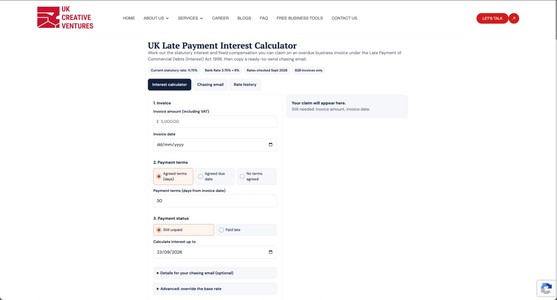
Use our free Late Payment Interest Calculator to estimate the interest that may be due on an overdue business payment. Enter the relevant invoice amount, dates and applicable interest rate to get an indication of the interest that could accumulate while a payment remains outstanding.
Simple Description:
Calculate potential interest on overdue business invoices and late payments.
Detailed Description:
Late payments can create significant cash-flow challenges for businesses, particularly small businesses that rely on customers paying invoices on time. When an invoice remains unpaid beyond its agreed due date, a business may have the right to charge interest depending on the circumstances, the contract between the parties and applicable legislation.
Our free Late Payment Interest Calculator helps businesses estimate the amount of interest that may accumulate on an overdue payment. By entering the relevant payment information, users can get a clearer indication of the potential interest associated with an outstanding invoice.
Understanding the potential cost of late payment can be useful when managing accounts receivable and following up on unpaid invoices. Instead of simply knowing that an invoice is overdue, a business can calculate an estimated interest amount and use that figure when reviewing its outstanding payments.
The calculator may be particularly useful for small businesses, freelancers, contractors, consultants, agencies and other businesses that issue invoices to customers or clients. Even a relatively small number of overdue invoices can create cash-flow pressure, especially when the business has its own suppliers, employees and operating expenses to pay.
Late payment rules can be more complicated than simply applying a percentage to an invoice. The applicable interest rate, payment terms, type of transaction, contractual arrangements and relevant legislation can all affect whether interest can be charged and how it should be calculated. For UK businesses, statutory late payment rules may apply to certain business-to-business transactions, but there can be exceptions and different circumstances to consider.
This means the calculator should be used as an estimate rather than a definitive legal or financial calculation. The result may not account for every factor affecting your particular situation. Before adding interest to an invoice or pursuing an outstanding payment, businesses should check the terms of their contract and the latest applicable legal guidance.
The calculator can nevertheless provide a useful starting point for understanding the financial impact of overdue payments. It can help business owners quantify potential interest, review outstanding invoices and prepare for discussions with customers regarding payment.
For example, imagine a business has issued an invoice that has remained unpaid beyond its agreed payment date. Instead of manually calculating the number of overdue days and applying the relevant interest rate, the calculator can provide an estimate based on the information entered. This can save time and make the process easier to understand.
Late payment management is also closely connected to cash-flow management. Businesses that regularly experience overdue invoices may benefit from reviewing their payment terms, invoice processes, customer communication and credit-control procedures. Clear payment terms, accurate invoices and timely reminders can all help reduce the risk of payments being delayed.
The calculator can therefore be useful not only when an invoice is already overdue but also when reviewing a company's broader approach to payment management. Understanding how quickly interest can accumulate may highlight why consistent invoice follow-up and clear payment policies matter.
However, businesses should avoid assuming that every overdue invoice automatically qualifies for statutory interest. The legal position can depend on the transaction and circumstances. Contractual interest provisions may also differ from statutory provisions.
For this reason, always check the latest official UK guidance and your contractual terms before relying on a calculated figure. Where there is a significant dispute or substantial amount involved, professional legal or financial advice may be appropriate.
Our Late Payment Interest Calculator is designed to make the initial calculation quick and accessible. It can help you estimate potential interest, understand the financial effect of an overdue payment and support better invoice and cash-flow management.
Use the free Late Payment Interest Calculator to estimate the interest that may have accumulated on an overdue business payment and get a clearer picture of what may be due.
RELATED TOOLS

 Making Tax Digital Checker
Use our free Making Tax Digital Checker to find out whether Making Tax Digital … Learn more
Pricing Tag: Free

 Business Rates Calculator
Use our free Business Rates Calculator to estimate your business rates based on… Learn more
Pricing Tag: Free

 Octopus
LinkedIn automation made simple and effective. This all-in-one automation tool … Learn more
Pricing Tag: $ 6.99/monthly

 AI search optimisation in Hyderabad
Similarly, organizations targeting Telangana's growing digital economy can bene… Learn more
Pricing Tag: Free

 Marketing Budget Optimiser
Allocate your marketing budget more effectively by evaluating channel performan… Learn more
Pricing Tag: Free
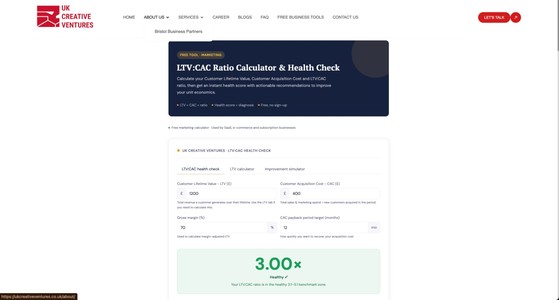
 LTV:CAC Health Check Calculator
Analyze the relationship between Customer Lifetime Value (LTV) and Customer Acq… Learn more
Pricing Tag: Free
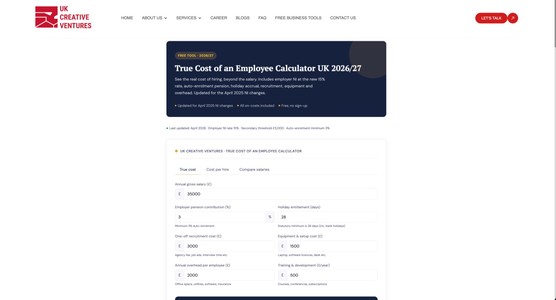
 True Cost of an Employee Calculator
Discover the full cost of employing staff beyond their salary. Calculate employ… Learn more
Pricing Tag: Free
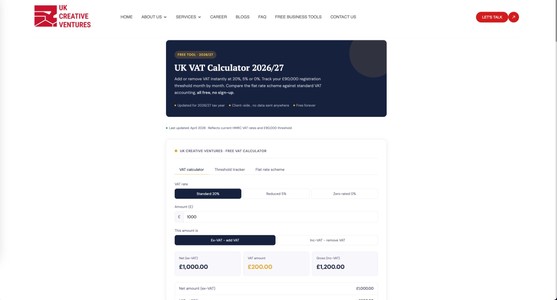
 UK VAT Calculator
Quickly calculate VAT-inclusive and VAT-exclusive amounts using current UK VAT … Learn more
Pricing Tag: Free
 Web design agency in Bangalore
At the core of any successful online strategy lies the foundation of a powerful… Learn more
Pricing Tag: Free
No comments yet.