Inside the Secretive AI Lab: A Glimpse into Physical Intelligence's Unmarked Headquarters
By admin | Jan 31, 2026 | 10 min read
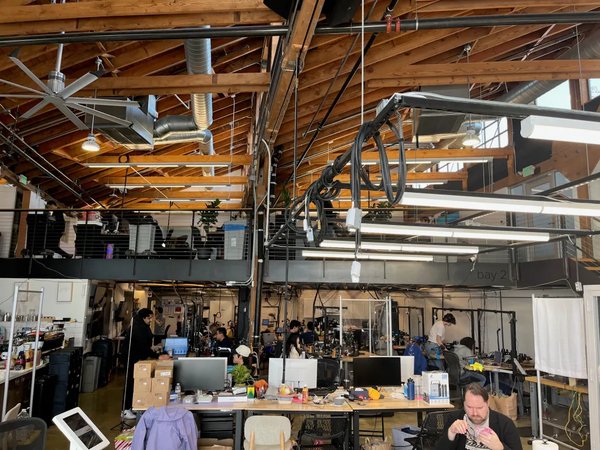
The sole clue to the location of Physical Intelligence’s San Francisco base is a pi symbol on the door, slightly off-color from the rest. Stepping inside reveals a bustling scene devoid of a reception desk or flashy signage. The vast concrete space is softened by an array of long, blonde-wood tables. Some serve as a casual lunch area, scattered with Girl Scout cookie boxes, jars of Vegemite hinting at an Australian presence, and baskets overflowing with condiments.
The other tables present a stark contrast, laden with monitors, spare robotics parts, coiled black wires, and fully assembled robotic arms engaged in mastering ordinary tasks. On my visit, one arm struggles to fold a pair of black pants. Another works with determined persistence to turn a shirt inside out, though success seems distant. A third appears proficient, swiftly peeling a zucchini before attempting to deposit the shavings into a separate container—at least the peeling is going smoothly.
Sergey Levine gestures toward this mechanical activity and offers an analogy: “Think of it like ChatGPT, but for robots.” Levine, an associate professor at UC Berkeley and a company co-founder, has the patient, bespectacled air of someone accustomed to explaining intricate ideas. 
He explains that this is a testing phase within a continuous loop. Data is gathered from these stations and other locations like warehouses and homes, which then trains general-purpose robotic foundation models. Newly trained models return here for evaluation. The pants-folder and shirt-turner are experiments, while the zucchini-peeler might be testing the model's ability to generalize the peeling motion to unfamiliar vegetables like apples or potatoes.
The company also runs test kitchens in this building and elsewhere, using standard hardware to expose robots to diverse settings. A sophisticated espresso machine sits nearby, which Levine clarifies is for robotic learning, not staff enjoyment. Any lattes produced are merely data points for the engineers, who are mostly focused on their computers or experiments.
The hardware is intentionally modest. These robotic arms cost about $3,500, which Levine notes includes “an enormous markup” from the vendor. In-house manufacturing could slash the material cost below $1,000. He recalls that just a few years ago, roboticists would be amazed such affordable hardware could perform any task—but that’s precisely the goal: superior intelligence compensating for basic hardware.
As Levine departs, Lachy Groom approaches with the brisk efficiency of someone managing multiple priorities. At 31, Groom retains the youthful appearance of a Silicon Valley prodigy, a reputation cemented early when he sold his first company just nine months after founding it at age 13 in Australia (hence the Vegemite). Earlier, when I asked for his time as he greeted visitors, his reply was blunt: “Absolutely not, I’ve got meetings.” Now he has perhaps ten minutes.
Groom discovered his focus after following the academic work from the labs of Levine and Chelsea Finn, a former Levine PhD student now leading her own robotic learning lab at Stanford. Their names consistently surfaced in groundbreaking robotics research. Hearing rumors they might start a venture, he contacted Karol Hausman, a Google DeepMind researcher and Stanford instructor involved in the project. “It was just one of those meetings where you walk out and it’s like, This is it.”
He never planned to be a full-time investor, despite a notable track record. After an early stint at Stripe, he spent about five years as an angel investor, backing companies like Figma, Notion, Ramp, and Lattice while seeking the right company to join or found. His first robotics investment in Standard Bots during 2021 rekindled his childhood passion for building Lego Mindstorms. He jokes that he was “on vacation much more as an investor,” but clarifies that investing was merely a way to network and stay engaged, not his ultimate aim.
“I was looking for five years for the company to go start post-Stripe,” he says. “Good ideas at a good time with a good team - [that’s] extremely rare. It’s all execution, but you can execute like hell on a bad idea, and it’s still a bad idea.” 
The two-year-old company has raised over $1 billion. When asked about its financial runway, Groom is quick to note that burn rate is relatively low, with most spending directed toward computing power. He adds that, given favorable terms with the right partners, he would raise more capital. “There’s no limit to how much money we can really put to work,” he states. “There’s always more compute you can throw at the problem.”
An unusual aspect of this arrangement is what Groom does not provide investors: a timeline for commercialization. “I don’t give investors answers on commercialization,” he says of backers like Khosla Ventures, Sequoia Capital, and Thrive Capital, who have valued the company at $5.6 billion. “That’s sort of a weird thing, that people tolerate that.” This tolerance may not last indefinitely, which motivates the company to secure ample funding now.
So what is the strategy, if not immediate commercialization? Co-founder Quan Vuong, formerly of Google DeepMind, explains it centers on cross-embodiment learning and diverse data. If a new hardware platform emerges tomorrow, they can transfer existing model knowledge without starting data collection from zero. “The marginal cost of onboarding autonomy to a new robot platform, whatever that platform might be, it’s just a lot lower,” he says.
The company is already collaborating with a handful of firms in sectors like logistics, groceries, and a local chocolate maker to test if their systems are viable for real-world automation. Vuong asserts that in some cases, they already are. With an “any platform, any task” philosophy, the potential for automating current tasks is broad.
Physical Intelligence is not alone in this pursuit. The competition to develop general-purpose robotic intelligence—a foundation for specialized applications, akin to the LLM boom three years ago—is intensifying. Pittsburgh-based Skild AI, founded in 2023, recently raised $1.4 billion at a $14 billion valuation and is pursuing a distinct path. While Physical Intelligence emphasizes pure research, Skild AI has already commercially deployed its “omni-bodied” Skild Brain, reporting $30 million in revenue within a few months last year from security, warehouse, and manufacturing applications. 
Skild AI has publicly critiqued rivals, arguing on its blog that many so-called “robotics foundation models” are merely vision-language models “in disguise” that lack “true physical common sense” due to over-reliance on internet-scale pretraining instead of physics-based simulation and real robotic data. This marks a sharp philosophical divide. Skild AI bets that commercial deployment creates a data flywheel that enhances the model with each real-world use. Physical Intelligence bets that avoiding near-term commercial pressure will yield superior general intelligence. Determining who is “more right” will take years.
For now, Physical Intelligence operates with what Groom calls unusual clarity. “It’s such a pure company. A researcher has a need, we go and collect data to support that need - or new hardware or whatever it is - and then we do it. It’s not externally driven.” The team initially had a 5- to 10-year roadmap of achievable goals, but by month 18, they had surpassed it.
The company employs about 80 people and plans to grow, though Groom hopes “as slowly as possible.” He identifies hardware as the foremost challenge. “Hardware is just really hard. Everything we do is so much harder than a software company.” Hardware breaks, arrives late—delaying tests—and safety concerns add complexity.
As Groom hurries off to his next meeting, I observe the robots continuing their practice. The pants remain imperfectly folded. The shirt is still right-side-out. The zucchini shavings accumulate neatly. Obvious questions linger, including whether people truly want vegetable-peeling robots in their kitchens, concerns about safety, pets reacting to mechanical intruders, and whether this investment addresses significant problems or creates new ones.
Meanwhile, outsiders question the company’s progress, the feasibility of its vision, and the wisdom of betting on general intelligence over specific applications. If Groom harbors any doubts, he doesn’t show them. He’s collaborating with experts who have worked on this problem for decades and believe the timing is finally right, which is assurance enough for him.
Silicon Valley has long backed visionaries like Groom, granting them considerable leeway from the industry’s inception. The understanding is that even without a clear commercialization path, a set timeline, or certainty about the future market, they might just figure it out. This approach doesn’t always succeed, but when it does, it often justifies the many attempts that did not.
RELATED ARTICLES



Comments
Please log in to leave a comment.

No comments yet. Be the first to comment!