A Man's Fall Awakens a Family's Forgotten History in Rural Hawai'i
By admin | Feb 20, 2026 | 8 min read
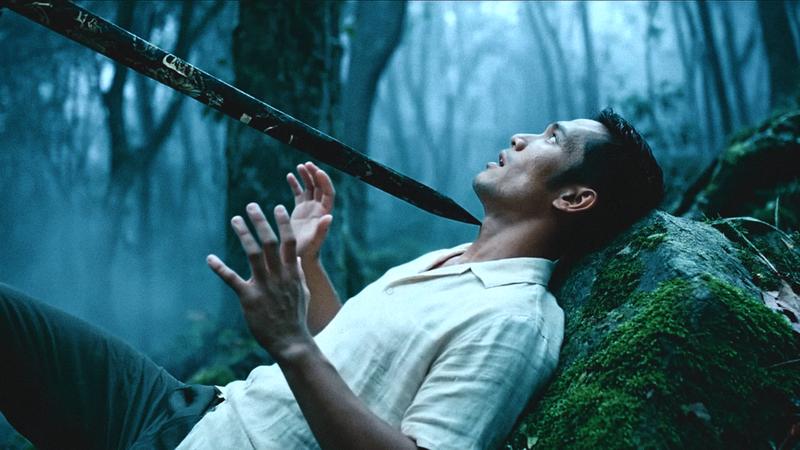
A man from the Philippines walks through the grass in the backyard of his childhood home in rural Hawai’i. Birds chirp in the tropical air as he nears a shrine placed beneath a starfruit tree. He bends down to look at a framed black-and-white photo of a woman with a 1950s side part in her hair. A sudden gust of wind shakes the branches, toppling the shrine’s contents. Stepping back, he trips on a root and strikes his head. When he wakes, he is in a dark, misty forest with a woman in a clay mask standing over him, a sword in her hand. “Who are you who dares to sleep under the sacred tree?” she demands in Ilocano, a Filipino dialect spoken in Hawai’i, pressing the sword to his throat. He says he is lost and tries to run. She pursues him, alternating between running and floating through the air. He falls. As she advances with her sword raised, he throws a rock that shatters the clay mask, revealing half of her face. “Mom?” he asks.
This is the opening scene of “Murmuray,” a short film by independent filmmaker Brad Tangonan. In style—from its tactile natural shots to its dreamlike, desaturated highlights—it felt consistent with his earlier work. The sole difference was that he created it using AI.
Tangonan was among ten filmmakers selected for Google Flow Sessions, a five-week program that provided creatives with access to Google’s AI tools, including Gemini, the image generator Nano Banana Pro, and the film generator Veo, to produce short films. The projects varied widely in scope. Hal Watmough’s “You’ve Been Here Before” blended hyperreal visuals with cartoonish stylization to playfully examine the importance of morning routine, while Tabitha Swanson’s “The Antidote to Fear is Curiosity” offered a more esoteric, philosophical dialogue about our relationship with AI and ourselves.
None of these short films, screened at Soho House New York late last year, felt like generic AI content. Each filmmaker I spoke with noted that AI had allowed them to tell a story they otherwise lacked the budget or time to realize.
“I see all of these tools, whether it be a camera you can pick up or generative AI, as ways for an artist to express what they have in their mind,” Tangonan remarked after the screenings. This idea—that AI is simply another tool for creators—is a message Google has actively emphasized.
Google isn’t mistaken; as video generation technology improves, AI will increasingly become part of a creator’s toolkit. In 2025, companies like Google, Runway, OpenAI, Kling, Luma AI, and Higgsfield progressed far beyond the uncanny, prompt-based novelties of the previous year. Bolstered by billions in venture capital, the AI video industry is now shifting from prototype to post-production.
Yet this era of AI abundance, which promises to “democratize access” to filmmaking, also threatens to erase jobs and stifle creativity under an avalanche of low-effort content. The existential stakes have divided creatives. Those who use AI risk being seen as complicit; those who avoid it risk obsolescence. The question is no longer whether these tools belong in the toolkit—they are arriving regardless. Instead, we must ask what kind of filmmaking survives when the industry prioritizes speed and scale over quality, and what happens when individual artists use the same tools to create work that truly matters.
The arguments against AI in filmmaking are numerous and come from some of the industry’s most prominent voices. Filmmaker Guillermo del Toro stated last October that he would rather die than use generative AI to make a film. James Cameron recently called the idea of generating actors and emotions via prompts “horrifying” in a CBS interview, arguing that generative AI can only produce a blended average of everything humans have done before. Werner Herzog said AI-created films “have no soul,” adding, “The common denominator, and nothing beyond this common denominator, can be found in these fabrications.”
Cameron and Herzog contend that AI removes the wheel of creation from human hands and cannot authentically convey lived experience. Tangonan, who describes “Murmuray” as a “family story,” agrees with that sentiment in part. “AI is a facilitator,” Tangonan said. “I’m still making all the creative decisions. When people see ‘AI slop’ online, it’s a lot of lowest common denominator stuff. And, yeah, if you hand over the keys to AI, that’s what you’re going to get. But if you have a voice and a creative perspective and a style, then you’re going to get something different.”
Using AI in filmmaking does not mean simply prompting a film into existence. For “Murmuray,” Tangonan wrote the script without AI and assembled visual references for a shot list. He then fed that material into Nano Banana Pro to generate images that matched his style, which became the foundation for video generation. Filmmaker Keenan MacWilliam similarly worked to ensure her short film “Mimesis,” a fictional guided meditation, was a “true extension of [her] visual language, rather than a ‘blender’ of other artists’ work.”
MacWilliam wrote the script and recorded her own voice for the mock meditation, which was both relaxing and humorous. On screen, against a dark, watery backdrop, psychedelic images of flowers and plants blended into one another, turned to smoke, morphed into seahorses, and swam away. All the imagery originated from MacWilliam’s personal collection of scanned flora and fauna—she travels everywhere with her scanner. “I made a choice to avoid using AI for anything that I could have shot with a camera or ask my collaborators to animate. My goal was to unlock new forms of expression for my established themes and style, not to replace the roles of the people who I like to work with.”
This was a common theme among the filmmakers I spoke with at the Google Flow event—the desire to use AI only when relying on other humans wasn’t feasible, or when AI’s unique, strange output served the story. For instance, Sander van Bellegem’s “Melongray” explored life’s acceleration through trippy visuals. In one shot, a salamander transforms into a balloon. This wasn’t in his original plan, but he was inspired by how AI allowed him to push the boundaries of both imagination and physics.
Today’s film studio budgets are being squeezed by rising production costs, the shift to streaming, and risk-averse corporate consolidation. As a result, major spending is reserved for predictable revenue generators—like the latest Marvel movie—while original mid-budget films have largely been abandoned. Introducing AI risks exacerbating this scarcity mindset, potentially leading studios to replace anything they can—actors, sets, lighting—with AI, regardless of artistic cost.
However, the efficiencies AI introduces could also lower barriers, making it easier for studios to produce original work. Even Cameron noted in his CBS interview that generative AI might reduce VFX costs, potentially enabling more imaginative sci-fi and fantasy films—genres often limited to expensive existing IP like “Avatar.”
The flying sequence in “Murmuray” would have required expensive VFX or complex on-set rigging, both beyond the budget of a short film, according to Tangonan. Yet even filmmakers who recognize AI’s efficiency benefits understand the risks to artistic expression. “I think efficiency in general is not the best friend of creativity,” MacWilliam observed.
For independent filmmakers, having such powerful tools at their disposal is both a blessing and a curse. It “democratizes access,” but it also often means working alone. The more one can do independently, the less incentive there is to collaborate. “It should be a collaborative process because the more people that are involved, the more accessible it is by everyone and the more it reaches and connects with people,” one filmmaker noted.
Directors make creative decisions, but not all of them. The filmmakers I spoke with found themselves suddenly taking on the roles of set designer, lighting director, and costumer—tasks requiring expertise they didn’t possess. This was frustrating and draining, pulling them away from the creative work they valued. It was also unsettling to consider how an entire professional ecosystem could be disrupted so quickly.
While the filmmakers generally expressed reluctance to replace actors with AI, some acknowledged that AI-generated performers are an inevitability for smaller studios. The tools to generate actors, their emotions, and their movements exist and are rapidly improving. AI video startups like Luma AI, which raised a $900 million Series C last November, are developing technology that allows an actor’s performance to be captured once and then altered using AI to change the character, costume, or set.
“In an ideal world, I would work with real actors and a cinematographer and department heads and the full crew to make something amazing and use AI to complement that, to do things we can’t do on set, whether for budgetary or time reasons,” Tangonan said.
“I think making any creative work that uses new technology always requires a certain kind of gut check and a willingness to have conversations around the work,” Swanson reflected. “These are tools,” she added. “How are you going to use the tool? Are you going to be ethical about it? Are you going to ask questions? Are you going to be transparent and share knowledge?”
However, many do not view AI tools as neutral. Beyond labor displacement, significant copyright concerns persist. AI video generation startup Runway has reportedly scraped thousands of hours of YouTube videos and copyrighted studio content. Others—including Google, OpenAI, and Luma AI—have faced questions about whether they are training their models on copyrighted films and stock footage without permission. (Some tools, like Moonvalley’s Marey, are trained exclusively on openly licensed data.) There are also environmental impacts; some estimates suggest generating seconds of AI video can consume as much electricity as hours of streaming.
Unsurprisingly, many of the filmmakers I spoke with said they face stigma for experimenting with AI. “Whenever I do post things online, a lot of my filmmaking colleagues have a very knee-jerk reaction to it, that we should all hold the line and not use any of these tools,” Tangonan shared. “I just don’t agree with that.”
If filmmakers are too hesitant to openly discuss how AI can and should be used—and where the ethical boundaries lie—then the conversation may be decided for them. Not by artists seeking to use it responsibly, but by efficiency-driven studios focused more on profit than art. “The film industry is floundering because people aren’t innovating and everything costs too much. We need tools like this for it to survive,” Watmough argued. “I think it’s essential that people engage with it because if we don’t, then it’s going to become something we don’t recognize, and that’s not sustainable.”
RELATED ARTICLES

Comments
Please log in to leave a comment.

No comments yet. Be the first to comment!