Anthropic's Claude Code Drives Q2 Operating Profit as AI Coding Tool Hits 900% Net Revenue Retention
By admin | Oct 28, 2026 | 3 min read
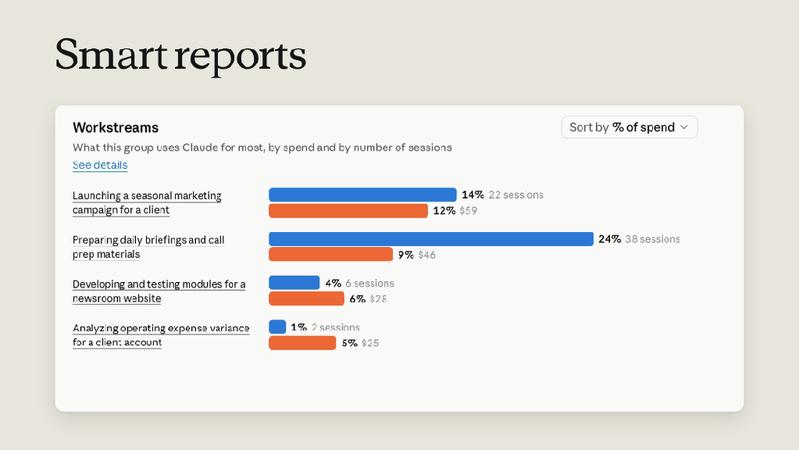
Anthropic's recent investor disclosures reveal that Claude Code, its AI-powered coding assistant, has become a genuine commercial triumph. The company posted an operating profit for the second quarter and reported an extraordinary 900% net revenue retention rate—meaning that spending from the same customer base in Q3 2025 multiplied ninefold by Q3 2026. With a clear emphasis on keeping enterprise clients engaged, Anthropic unveiled a new set of reporting tools on Wednesday aimed at giving those customers a more detailed picture of the value they extract from their token expenditures.
These tools allow managers to examine a team's output over a specified time period using internal analytics and employee surveys—revealing what the team accomplished, what it cost, and where workflows encountered problems. By default, Anthropic says it will not use this data for model training. The reports additionally provide suggestions for enhancing results.

This move represents a straightforward effort to showcase the return on investment of Anthropic's offerings and to help customers improve it—a significant priority for large enterprise clients. Anthropic is also introducing pooled group budgets so teams can more effectively manage their token spending. Organizations have been actively seeking this kind of insight as they determine the best ways to implement AI tools. While token spending is being driven by usage among venture-backed companies, the majority of Fortune 500 firms are not yet realizing substantial benefits from their AI deployments. Jellyfish, a company that develops tools for software developers, published a new report yesterday drawing on agentic coding tool usage by 276,000 of its customers. Claude Code and other tools built on Anthropic models remain the most widely adopted in the survey, accounting for nearly one-third of all proposed code changes submitted for review. Even more notably, spending on these tools has increased tenfold since the start of the year, with their cost now representing roughly 2% of total engineering expenses. We're certainly reaching the point where people recognize that simply spending a lot isn't sufficient—you now need to optimize it and make it work effectively."
Anthropic's new reports directly address that challenge. Anthropic holds the lead among enterprise customers, but pinpointing what makes an agentic coding tool genuinely sticky is difficult. The summer release of OpenAI's Astra model appeared to pose a potential threat to Anthropic, yet it hasn't slowed Anthropic's adoption figures so far. Looking at X, he continued, you'd get the distinct impression that the competition is more heated. "Everyone in the Valley is like, 'Oh, Codex is better.'" In reality, Albarran continued, "Anthropic was just there with great enterprise motions, and they had an incumbent weight of their own—this stuff just worked and worked well, and a lot of people just put a lot of effort into standardizing workflows around it. And there's not a big enough reason to switch."
It's not merely a matter of models and workflows, either. Business realities mean that once a frontier lab has established itself within a customer organization, switching becomes harder than it would be for an individual programmer or small organization. Albarran points to the investment all the major AI labs are making in forward-deployed engineering (FDE) organizations—teams that embed AI consultants inside customer organizations to help them get started. These new reporting tools can be viewed as a kind of FDE-lite, a lighter version of that hands-on assistance, for Anthropic customers. "We're at a point now where it's mature enough, where once you're in, it's going to be harder and harder to switch because you've spent the effort," he said. "Even if they're all mostly the same, they're all going to be slightly different, have their own slight quirks of how they handle agents to ND files, etc., and so that cost to switch is not zero."
RELATED ARTICLES



Comments
Please log in to leave a comment.

No comments yet. Be the first to comment!