Bond Launches to Combat Social Media Addiction with IRL-Focused Platform
By admin | Apr 21, 2026 | 5 min read
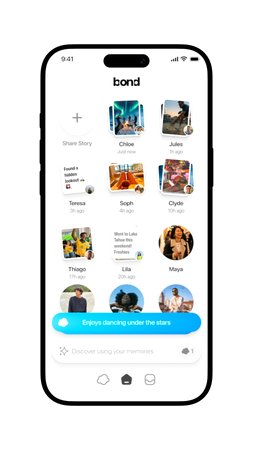
Traditional social media platforms have been engineered to captivate our attention, keeping us tethered to screens with endless streams of memes and trivial videos, all to cultivate more engaged audiences for advertisers. In response to growing user fatigue, a wave of new companies has emerged, encouraging real-world interactions or offering products free from addictive features like infinite scrolling. Bond, which debuted publicly on Tuesday, is part of this movement. According to Dino Becirovic, Bond's co-founder and CEO, the platform provides an AI-driven answer to widespread screen addiction.
The site functions similarly to conventional social networks, allowing users to share updates about their recent activities. Users can post what Bond terms "memories" using photos, videos, or audio clips to refresh their profiles. What sets Bond apart is its purpose as a catalyst for real-world action. The experiences users log train its AI system to offer personalized, event-based suggestions. For example, frequent posts about missing pho might prompt a recommendation for a highly-rated local Vietnamese restaurant. Similarly, an interest in heavy metal could trigger an alert about an upcoming Iron Maiden concert nearby. Becirovic explains that the more you share your experiences, the more refined the recommendations become. Essentially, the system aims to pull you away from the app and into actual life, encouraging activities beyond "bed rotting" or "doomscrolling."

Visually, the interface resembles Instagram, but it lacks a continuous feed. User profiles are displayed in clustered groups. Selecting a profile reveals that person's current stories, which vanish from public view after 24 hours but remain stored privately. Users can revisit their personal memory archive at any time. Bond's team includes veterans from major platforms like TikTok, Twitter, and Facebook. Becirovic's background includes roles at Kleiner Perkins and Index Ventures, while founding researcher Arthur Bražinskas previously co-led user signal integration for Google Gemini.
A key question is how such a company plans to generate revenue, given that most social media relies heavily on advertising. Bond currently has no ads. Interestingly, Becirovic foresees a future where users could license their own archived data from Bond to sell to companies for AI training. In this model, Bond would collect a minor licensing fee, creating steady revenue and establishing itself as a data source for AI firms refining their models. "The idea behind this licensing model is that you can monetize your memories," he stated. "If we build a platform that incentivizes billions to document daily life, we naturally become a prime destination for training future AI models like GPT-6 and GPT-7."

An alternative approach involves using accumulated data to power product recommendations integrated with e-commerce sites, with user consent. Becirovic emphasized that Bond would never sell data for advertising, and users maintain control: they can delete memories via the Memory tab or through natural language commands in Memory chat. He added, "Users can also delete their profile if they aren't finding value. As we grow, we'll introduce more privacy features for data management."
Regarding security, Becirovic noted that end-to-end encryption is a near-future priority post-launch. Currently, all user data is stored securely in protected databases. For now, the primary focus is on perfecting the user experience. "Monetization is not a short-term priority," Becirovic said. "Our initial goal is to create an app where users gain more value the more they preserve their memories."
RELATED ARTICLES

Comments
Please log in to leave a comment.

No comments yet. Be the first to comment!