Clawdmeter Debuts: Open Source Desktop Dashboard Reveals Real-Time Claude Code Token Usage Stats for AI Power Users
By admin | May 14, 2026 | 4 min read
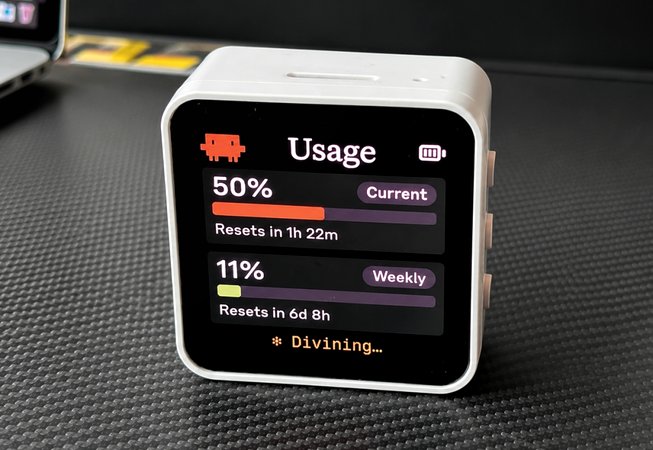
Silicon Valley's era of maximizing AI token usage now has its own dedicated piece of hardware. A newly released open-source project transforms your Claude Code usage statistics into a compact desktop dashboard, giving AI power users a way to monitor their consumption at a glance. While you can track Claude Code usage directly in the terminal with commands or through external tools and apps, nothing beats watching a pixel-art version of the Clawd sprite dance across a screen before displaying your token usage data, right? Dubbed the "Clawdmeter," this device serves both as an entertaining side project for AI enthusiasts and as a clear sign of how deeply Anthropic's Claude has embedded itself within the developer community, along with the rising interest in tokenmaxxing. This emerging "productivity" trend involves software engineers at various tech companies striving to maximize the number of AI tokens they consume at work, using it as a metric for how fully they've adopted AI. As one Reddit user joked upon seeing the project for the first time: "At this point, Anthropic should just mail these to us for free." Another suggested adding a button to increase capacity or top up more tokens using your card on file. (Ha, that could be dangerous.)
The concept for the project originated from Reykjavik, Iceland-based software developer Hermann Haraldsson, who mentioned he had always wanted to experiment with embedded devices but never found the time before. However, Claude guided him through the process in just a few days, he said. "It's really democratized access to programming, so that anyone can now do what developers used to do. I think that's really positive, actually." Most of the time Haraldsson spent building the device focused on design, ensuring the font, colors, and small animations were just right. To create your own dashboard, you can use a small lithium-ion battery-powered display like the Waveshare ESP32-S3-Touch-AMOLED-2.16, which connects to your laptop via Bluetooth. When the device powers on, the splash screen shows pixel-art Clawd animations that become more active as your usage rate increases. You can also press the middle button to cycle through different animation styles if you prefer. "I like it when I'm working, and I see it going crazy - it's like a little dopamine loop," notes Haraldsson. The animation stays on the screen until you press the middle button, which then reveals your session and weekly Claude usage data in simple charts. Press this button again to cycle to the Bluetooth screen, which shows connection status and includes a reset feature. From there, you can tap the screen to return to the original splash screen animation.

Meanwhile, two additional side buttons send Space and Shift+Tab over Bluetooth for Claude Code's voice mode and mode-toggle shortcuts. The latter allows you to switch between the default Normal mode, "Accept Edits" mode, Plan Mode, and Auto Mode. Haraldsson says the device stays synchronized with your usage limits because it reads your Claude Code OAuth token to make an API call, which then retrieves the usage numbers directly from the response headers. Since Clawdmeter is an open-source project, anyone can fork it to add their own features, animations, screens, and more, tailored to their specific interests and needs. Haraldsson was surprised to find that over 800 people have starred it on GitHub since its May 10 launch, with 50 already forking the project for their own development. He believes the device appeals to them because it evokes a nostalgic feeling. "There's a kind of nostalgia for when you used to have a hardware device for everything - like a Walkman to play music, or an iPod," says Haraldsson. (Or, as one Redditor put it, the Clawdmeter is like a "hardware Tamagotchi for my context window.") "I know it's not replacing anything - like, you could have this on your computer - but it's just fun," Haraldsson says.
RELATED ARTICLES


Comments
Please log in to leave a comment.

No comments yet. Be the first to comment!