David Sacks Steps Down as Trump's AI and Crypto Czar, Takes New White House Role
By admin | Mar 27, 2026 | 3 min read
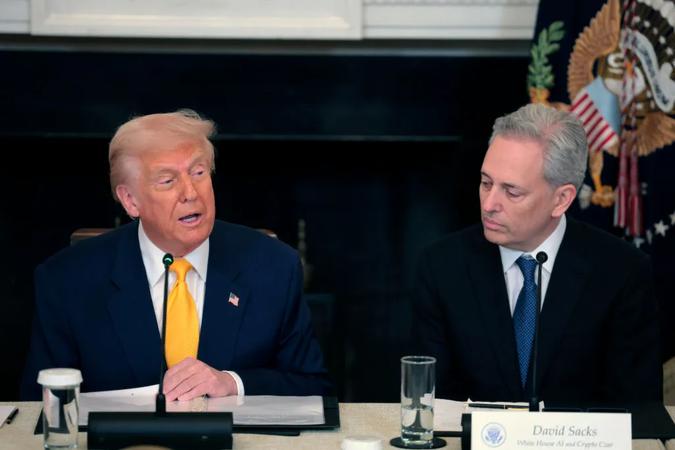
David Sacks has concluded his tenure as Donald Trump's advisor on artificial intelligence and cryptocurrency. In a Thursday interview with Bloomberg, the seasoned entrepreneur, investor, and podcast host confirmed that his non-consecutive 130-day appointment as a special government employee has ended. He is now transitioning to serve as co-chair of the President’s Council of Advisors on Science and Technology (PCAST), alongside senior White House technology adviser Michael Kratsios. Sacks explained in a video interview, "Moving forward as co-chair of PCAST, I can make recommendations on not just AI but an expanded range of technology topics. So yes, this is how I’ll be involved moving forward."
In practical terms, this shift places Sacks considerably farther from the center of power in Washington compared to his earlier role in this second Trump administration. As AI czar, he enjoyed direct access to Trump and played a part in shaping policy. PCAST, however, is a federal advisory group. While it examines issues, prepares reports, and forwards recommendations, it does not create policy. The council has existed in various forms since Franklin D. Roosevelt's presidency. Sacks emphasized to Bloomberg that this latest version boasts "the most star power of any group like this" ever assembled—a claim that is difficult to dispute. The initial roster of 15 members includes Nvidia’s Jensen Huang, Meta’s Mark Zuckerberg, Oracle’s Larry Ellison, Google co-founder Sergey Brin, Marc Andreessen, AMD’s Lisa Su, and Michael Dell, among other notable figures.
Sacks informed Bloomberg that the council will focus on AI, advanced semiconductors, quantum computing, and nuclear power. Immediate attention will be directed toward advancing Trump’s national AI framework, which was released just last week. This framework aims to replace what Sacks described as a confusing array of conflicting state-level regulations. "You’ve got 50 different states regulating this in 50 different ways," he noted, "and it’s creating a patchwork of regulation that’s difficult for our innovators to comply with."
Sacks did not directly address why this transition is occurring now or whether his recent public remarks played a role. Earlier this month, on the popular "All In" podcast he co-hosts, Sacks openly encouraged the administration to seek an exit from the U.S.-backed conflict with Iran. He outlined a series of escalating risks—such as attacks on oil infrastructure in neighboring countries, the destruction of desalination plants, and the potential for nuclear escalation by Israel—and called for a diplomatic off-ramp. Trump later told reporters that Sacks had not discussed the war with him. The conflict between the U.S., Israel, and Iran has now lasted approximately 27 days.
When Bloomberg asked about the podcast episode on Thursday, Sacks essentially distanced himself, stating, "I’m not on the foreign policy team or the national security team." He clarified that his podcast comments reflected his personal views, not an official stance. Despite the high-profile names Sacks is bringing to PCAST, it is useful to consider the council’s historical role: an advisory body that has wielded significant influence in some administrations and very little in others.
President Obama’s PCAST was notably productive, producing 36 reports over eight years. Two of those reports led to tangible policy changes, including an FDA rule that expanded access to over-the-counter hearing aids. In contrast, President Trump’s first-term council took nearly three years just to appoint its initial members, generated only a handful of reports, and left no major policy imprint. President Biden’s version leaned heavily toward academia, featuring Nobel laureates, MacArthur fellows, and National Academy members, and issued a modest number of reports before the administration concluded. The current PCAST is distinctly different, composed almost entirely of top executives from the very companies shaping the technologies it will advise on. Now, Sacks returns to being one of those unencumbered executives, free to resume his career as an investor and entrepreneur.
RELATED ARTICLES
Comments
Please log in to leave a comment.
No comments yet. Be the first to comment!