Digg Reboot Revives Again After Shutdown, Plans Comeback with New Strategy to Combat Bot Traffic
By admin | May 11, 2026 | 7 min read
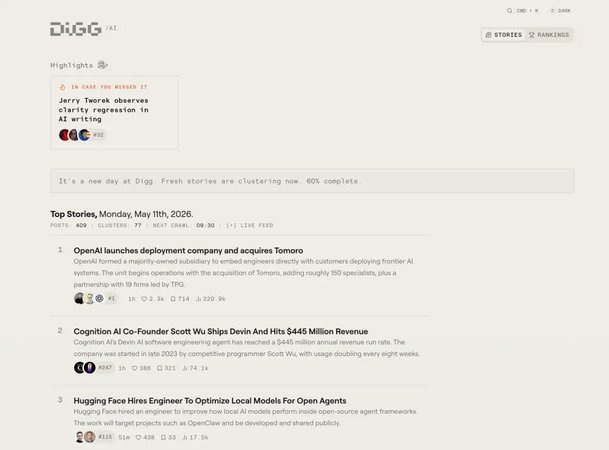
Digg has once again risen from the dead. Just a few months after its latest relaunch, the revived version of Kevin Rose's once-popular link-sharing platform shut down in March as the company pivoted directions. Originally positioned as a competitor to the massive community forum Reddit, the new Digg discovered it couldn't effectively manage the bot traffic flooding its platform and hadn't set itself apart enough from rivals to make a real impact. The startup laid off employees and announced it was time to start over from scratch. Rose, a partner at True Ventures, returned to work full-time on a fresh version of Digg in April. On Friday evening, the founder shared a preview link to the newly redesigned Digg, which now bears little resemblance to a Reddit clone and instead looks more like the news aggregator it originally was.
This time around, the site focuses on ranking news — specifically, AI news to start. In an email to beta testers, the company explained that the site's goal is to "track the most influential voices in a space" and highlight the news truly worth "paying attention to." AI serves as the initial test area, but if successful, Digg plans to expand into other topics. The email cautioned that the site remains raw and "buggy," designed more to offer users a sneak peek than to serve as a public launch. On the current homepage, Digg features four main stories at the top: the most viewed story, a story with rising discussion, the fastest-climbing story, and one "In case you missed it" headline. Below that sits a ranked list of top stories for the day, complete with engagement metrics like views, comments, likes, and saves. The twist: these metrics don't come from Digg itself. Instead, Digg pulls content from X in real-time to determine what's being discussed, while also performing sentiment analysis, clustering, and signal detection to identify what matters most. As Rose noted on X, when OpenAI CEO Sam Altman engages with an AI story, it almost always triggers a chain reaction of deep discussion and topic propagation across X. The new Digg can track that increased engagement.

This feature might appeal to data enthusiasts, as it reveals the impact of X-based engagement through charts and graphs and offers a way to pick out signals amid the noise that often dominates X. However, it's unclear whether everyday users will find enough underlying value beyond seeing that a @sama tweet can spark viral trends. The site also ranks the top 1,000 people involved in AI, along with the top companies and politicians focused on AI issues.

For those who lack time to scroll through X tracking breaking AI news, Digg could prove a handy resource. But it's not obvious why people would regularly turn to Digg over their preferred news app, RSS reader, or even their X "For You" feed when catching up on trends — especially since there's currently no discussion happening on Digg's site itself. Digg may also face challenges when it branches into other topics, as AI news remains one of the few areas where discussion still thrives on X. Other verticals lack the same momentum, particularly after Musk's takeover of the platform formerly known as Twitter spawned a host of competitors, including Meta's creator-focused Threads. Many non-tech discussions now occur off X or entirely off the public internet. Still, if Digg gains traction, it could become a valuable source of website traffic for publishers whose businesses have been battered by declining clicks due to Google's shifting algorithms and the impact of AI Overviews — the AI-generated summaries Google displays atop search results, which often answer users' questions before they ever click through to a website.
RELATED ARTICLES



Comments
Please log in to leave a comment.

No comments yet. Be the first to comment!