Google's AI Search Overhaul Sparks User Exodus to DuckDuckGo
By admin | May 26, 2026 | 3 min read
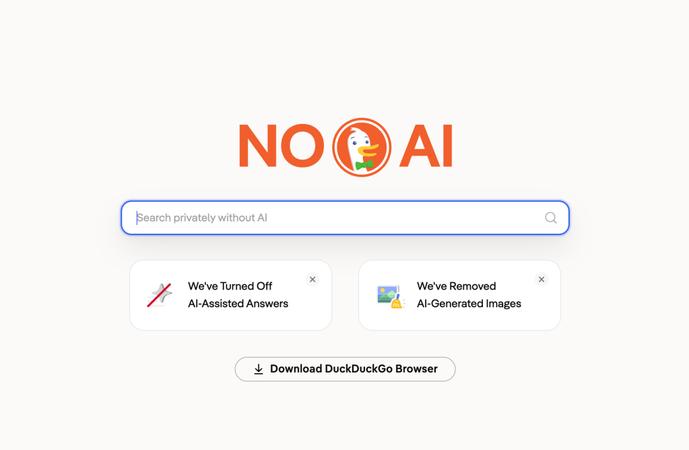
Last week, following Google's massive Search revamp, I overheard a woman on the phone saying she was moving to DuckDuckGo because you can "opt out of using AI."
"Google just isn't Google anymore," she remarked. It appears many shared her sentiment. At I/O, Google’s annual developer conference, the company announced that its classic list of blue links is being replaced by an AI agent that answers questions, carries out tasks, and runs background monitoring tools. The backlash has been intense. Some critics argue this will destroy the open web, while others worry that AI overviews display inaccurate answers and remove control from users who may not want AI involvement. It also complicates simple actions—just try Googling the word "disregard."
In response to Google’s changes, numerous users have started migrating to DuckDuckGo, a privacy-focused search engine that has never managed to break Google’s dominance, holding only about 2% of the U.S. search market. During Google’s search antitrust trial in 2023, DuckDuckGo CEO Gabriel Weinberg testified that Google’s exclusive default search contracts hindered its ability to become the default on other browsers. "Google is force-feeding AI with no way to opt out," Weinberg said Tuesday in a statement about Google’s Search overhaul. "As a result, their results are getting worse, not better. We want to be the place that puts users in charge and allows them to decide how much or how little AI they want."
Now, DuckDuckGo appears to be benefiting as consumers flee AI. The company reported that U.S. app installs rose an average of 18.1% week-over-week during the May 20 to May 25 period, compared to May 13 to May 18. This growth was sustained for six consecutive days and peaked at 30.5% on May 25. On iOS, the install rate was even higher, with week-over-week growth averaging 33% and peaking at 69.9%. The search engine also noted that visits to its AI-free search page, noai.duckduckgo.com, averaged 22.7% week-over-week growth, peaking at 27.7% on May 24. This page disables all AI features, such as AI-assisted answers and AI-generated images, by default. The company said the trend is stronger in the U.S., and DuckDuckGo continued gaining users over the Memorial Day weekend, a period when traffic usually dips.
DuckDuckGo offers its own AI product called Duck.ai. It’s free and doesn’t require an account, but provides access to models including Anthropic’s Claude 4.5 Haiku, Meta’s Llama 4 Scout, Mistral’s Small 3 24B, and OpenAI’s GPT-5 mini. All chats are private because DuckDuckGo strips the user’s IP address before requests reach model providers, deletes conversations within 30 days, and prevents chats from being used for training. "Not only do we respect user choice, but also user privacy," Weinberg said. "Everything you do in DuckDuckGo is private, we don’t collect search histories or chats and nothing is used for AI training."
DuckDuckGo also provides Search Assist, similar to Google’s AI overviews, and an AI Image Filter that removes AI-created images from search results. Kamyl Bazbaz, DuckDuckGo’s chief communications and policy officer, said both of these AI features are among the company’s most popular, despite their differing philosophy. "People just want a choice," Bazbaz said.
RELATED ARTICLES


Comments
Please log in to leave a comment.

No comments yet. Be the first to comment!