Google DeepMind Unveils WeatherNext 3 AI Model for Faster, Sharper Weather Forecasting
By admin | Sep 03, 2026 | 6 min read
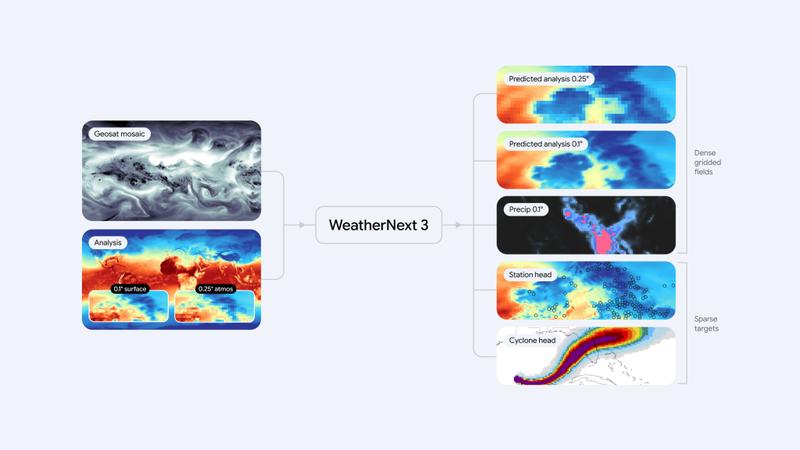
Scientists at Google DeepMind and Google Research have unveiled a new AI model for weather forecasting that offers a sharper view of our changing atmosphere and delivers predictions more frequently. Dubbed WeatherNext 3, this release marks the latest milestone in the deep-learning revolution reshaping meteorology. Google says the model will soon power weather insights across its products, including Search, Google Maps, and Gemini, while also being made available to users and researchers through Google’s cloud platforms. The model has already proven to be the most accurate among leading contenders evaluated on Operational WeatherBench, a comparison tool for AI forecasts developed by the startup Brightband, which assesses metrics such as temperature, windspeed, and humidity. Not only does it outperform other deep-learning systems from Google, Microsoft, Nvidia, and the European Center for Medium-Range Weather Forecasting, but it also surpasses traditional forecasts issued by the US National Weather Service and the ECMWF.

Most conventional weather forecasts originate from government-owned supercomputers that painstakingly process mathematical equations describing atmospheric physics. While these systems have achieved remarkable accuracy over time, they come with high costs and slower turnaround. In 2018, however, the ECMWF released more than half a century of weather data generated by such systems, opening the door for deep-learning researchers to train models capable of making predictions far more rapidly—and with accuracy comparable to government tools. "Weather is chaotic, and so small differences really start to perturb massively…Machine learning targets the problem we are really solving, which is approximate noisy physics from incomplete information and finite compute, and so it learns patterns from a lot of data," said Ferran Alet, a staff research scientist manager at DeepMind. Since then, model developers have been chipping away at the key weaknesses of AI forecasting: a tendency to predict over broad areas of 15 to 25 square kilometers, which isn’t always practical; struggles with precipitation accuracy; and a heavy reliance on formatted datasets produced by government agencies. WeatherNext 3 takes on all three of these hurdles. Its rainfall evaluations show a 60% improvement over WeatherNext 2, and it now generates hourly forecasts instead of the standard six-hour intervals.

These gains stem from deliberate design decisions. WeatherNext 3 is a larger model, boasting 2.4 times more parameters than its predecessor, with decoder heads fine-tuned to produce more actionable outputs. While most weather forecasts present metrics averaged across a 3D grid, the DeepMind team has already earned recognition for customizing their model to also map cyclone paths. This time, the designers trained the model to focus its predictions on specific weather monitoring stations. That shift matters not just for offering finer-grained forecasts, but also for enabling validation against concrete, ground-truth observations. "The idea, with a lot of AI applications, is to try to run tasks as end-to-end as possible," noted Daniel Rothenberg, an atmospheric scientist at Brightband. "Adding a capability where this model is now also predicting, say, what Denver’s airport’s weather station is going to measure on an hourly basis, just connects that forecasting task closer to the core."
The model’s ability to forecast more frequently stems from its capacity to ingest real-time weather satellite data collected every hour. Feeding AI models raw empirical observations—rather than the analysis products churned out by weather supercomputers—holds promise for more accurate predictions, though working with unformatted data remains technically demanding. Google asserts that WeatherNext 3 is the "first" AI model to directly integrate raw observations for a high-resolution global forecast. However, the AI weather startup WindBorne counters that its own model, WeatherMesh 6, has been incorporating raw observations from its fleet of weather balloons and other sources since late 2025. In response, Google points out that its forecasts offer higher resolution across the globe. Regardless of these claims, both models still depend on national weather datasets to generate forecasts, meaning true direct data assimilation will require further innovation.
While large language models tend to dominate the spotlight, the transformer revolution in meteorology has proven just as transformative. European and US weather agencies are already weaving AI models into their forecast products, and the speed and low cost of these tools promise to bring economic benefits to poorer regions where the expense of high-quality sensors and supercomputers has historically made accurate forecasting unattainable. Bill Gates recently highlighted AI-powered weather forecasting as a crucial advantage of the technology, noting that improved forecasts could boost crop yields in developing countries. Alet, the DeepMind researcher, added that higher-resolution predictions of wind, rain, and cloud cover will enhance the reliability of renewable energy initiatives. "At the end of the day, I think Google is about providing useful information to the user, and a lot of what users are looking for has to do with the weather in some way or another," Alet said.
RELATED ARTICLES



Comments
Please log in to leave a comment.

No comments yet. Be the first to comment!