Genesis AI Launches GENE-26.5 Model with Surprise Robotic Hands After $105M Seed Round
By admin | May 06, 2026 | 4 min read
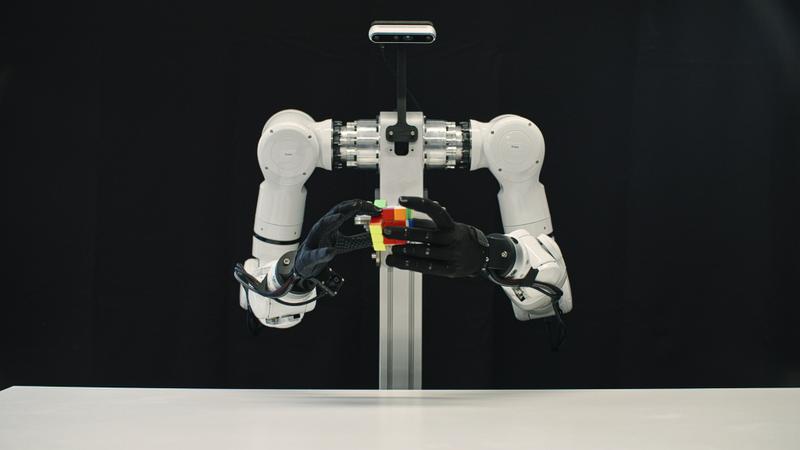
Genesis AI, a company that secured $105 million in seed funding to develop foundational AI for robotics, has introduced its first model, GENE-26.5—and it comes with a surprising feature: hands. In a demonstration video, the company showcased a series of advanced tasks performed by a set of robotic hands it designed internally. However, the company soon recognized it needed full control over the hardware. “So we decided to go full stack,” said the founder. Other well-funded firms operating at the intersection of AI and robotics include Physical Intelligence and Skild AI. The founder also acknowledged that “there’s probably 50 or 100 robotic hand companies out there.” But he and his co-founder, Théophile Gervet, believe that building their own hands will give them an advantage. The key difference is that Genesis’ hand matches the size and shape of a human hand—unlike the two-finger grippers many robotics companies use—reducing the gap with real-world conditions. “That lets us collect a lot more data than was previously possible, to train a model that can do many more tasks,” said Gervet, a former research scientist at Mistral AI who now serves as Genesis’ president.
Among the physical manipulation tasks shown in the video, Gervet’s personal favorite is cooking, because it demonstrates the robot’s ability to complete a long series of difficult actions, such as cracking an egg and slicing a tomato. But Genesis has also tasked its robots with making smoothies, playing the piano, and solving a Rubik’s cube—a classic robotics gimmick.
Other tasks, such as lab work, are closer to the potential commercial applications of Genesis’ technology. Yet what happens behind the scenes is equally important: the startup has developed a sensor-loaded glove that functions as a real-life counterpart to its robotic hand, collecting data that can be more readily used. “Our idea was that if we could design a robotic hand that tries to mimic a human hand as much as possible, we can instantly unlock huge amounts of human data without having to worry about what people call the ‘embodiment gap’ in robotics research,” said Xian. Others have tackled this problem before, but the main novelty is how Genesis combines the glove with its model. The current version is named GENE-26.5 for May 2026, but Xian expects many iterations thanks to the simulation the company has developed. “The real bottleneck for the iteration speed of the model is evaluation. So this helps us speed up model training a lot,” he said.
Beyond simulation, data will be key to training models that help robots perform more tasks. That’s where Genesis’ glove could prove valuable. Gervet noted that, unlike clunky data collection devices that get in the way, the glove is as light and easy to wear as the security gloves already used in many industries, while being relatively cheap to produce. “We’re in talks with a lot of customers right now, and a lot of the value of a glove would be that, for the first time, you can wear the data collection device when you’re doing your daily job, whether it’s a lab technician for pharma or for manufacturing,” Gervet said. This would be complemented by “egocentric video data”—people filming themselves performing tasks. Still, it remains uncertain whether workers would be willing to wear gloves and cameras that could train robots to replace them, or whether they would receive extra pay for that training. Gervet suggested that this would be a matter between Genesis’ customers and their employees. “We haven’t nailed the details yet,” he said. Either way, the founders acknowledged that customers might decide not to share that data with the startup. However, Genesis also has its own avenues for building its “human skill library”—it could pay third-party partners to collect data. Its model is already trained on “massive amounts of human-based internet videos,” according to a press release that didn’t mention compensation. Combined with its simulation system, this could help Genesis lower the costs of its technology for real-world applications like the one it has demonstrated.
“This marks an important milestone for their team and the robotics industry more broadly,” said Eric Schmidt, former CEO of Google, who invested in the startup. In July 2025, just a few months after its founding, the company emerged from stealth with a $105 million seed round co-led by Eclipse and Khosla Ventures, with additional backers including Bpifrance, HSG, and individuals like Schmidt, as well as Xavier Niel, Daniela Rus, and Vladlen Koltun. This funding helped Genesis increase its headcount. With offices in Paris and California, it has also expanded to London. “One big reason we decided to be in Europe is there is a huge talent density across the whole continent,” Gervet said. Its team of 60 people is split roughly “40-45% in Europe and 50-55% in the U.S.,” and the startup is currently hiring in all three locations. But he insisted that the roadmap remains unchanged. “Our goal is to build the most capable robotic system,” he said.
RELATED ARTICLES

Comments
Please log in to leave a comment.

No comments yet. Be the first to comment!