Maple Launches Privacy-First AI Assistant That Keeps Your Data Private—Even From the Company Itself
By admin | Nov 24, 2026 | 11 min read
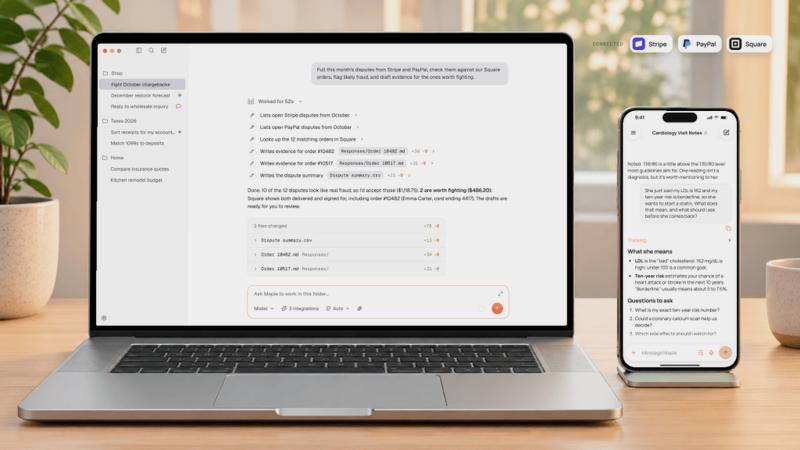
AI assistants are becoming increasingly powerful agents capable of reaching into our files, emails, calendars, and browsers—and with that capability comes a growing expectation that we trust the companies behind them. One startup, Maple, is charting a different course. Co-founded by a former Apple engineer who specialized in privacy-preserving technologies, Maple has built an AI app where user data stays private—even from the company itself.
"We wanted to build something that was not only encrypted but also could be proven, and that people could go look at the open-source code, and then they could look at what we call trusted execution environments," explains Maple co-founder and CEO Mark Suman. "They can look at and verify the code that's running on our servers, so they don't really have to take our word for it."
"They can audit everything themselves and know how their data is being handled," he adds.
Trust is the central theme for Maple. The startup's premise is that an AI app can exist where consumers don't have to sacrifice privacy for convenience—a trade-off competitors often demand through invasive privacy policies, extensive data collection, and sometimes even training on users' personal data. Rather than asking users to trust that Maple won't misuse their information, the company is building a business where it simply cannot access that data in the first place.

Like other AI apps on the market, Maple offers a chat experience where users ask questions and receive answers. Its newly launched desktop app, Maple Work, delivers a more agentic experience—the AI can control your computer, work with your files and apps, and operate your browser to handle online tasks. With a recently closed $5.3 million round, the company is moving on to its next product: a cloud-based agent that will be able to continue working even when your computer is off. This addition would make Maple more competitive with other popular consumer AI services, like Meta's Muse, Instinct, and other AI agents that operate over chat.
The oversubscribed seed round was led by EPIC Ventures, with participation from Draper Associates, Planetary VC, and Epoch VC, and follows a pre-seed angel round of under a million. Given the investor interest, Maple plans to raise a Series A in the first half of 2027.
At Apple, Suman worked on AI and machine learning with a particular focus on computer vision. Given Apple's stance on consumer privacy, the challenge he faced was building products that would protect people's identity while benefiting from computer vision techniques. His co-founder, Anthony Ronning (CTO), has a background in defense tech, security, and networking. Ronning started the company that later became Maple AI back in 2023, initially as a privacy-focused fintech. When Suman teamed up with Ronning in August 2024, the idea to create Maple AI was born. The following January, the product became available to the public as a mobile app.

The app offers a familiar interface for those used to AI chatbots, but under the hood it runs a variety of open models, including versions of DeepSeek, Kimi, GLM, Inkling from Thinking Machines, Google's Gemma, and OpenAI's GPT OSS. Users can pick and choose the models they want or, for a simpler experience, just toggle between a quick model and the more powerful one.
The models themselves run inside a Trusted Execution Environment (TEE)—meaning a server with hardware encryption on it—within a U.S.-based data center. (Maple also offers support for European customers through a partner that runs its server in Europe.)
"We actually don't have access to [the data] while it's inside the TEE," explains Suman. "The data gets encrypted first on your device using a unique password that's only known by you, the user—we don't have access to it. It then goes into this TEE, and it gets decrypted inside there. The AI does its thing, and then it re-encrypts it with your password and sends it back to you," he continues.
"So we provide an end-to-end experience that's very easy for the user, but we actually don't have access to the raw data as it's in flight or even when it's at rest," he adds.
This allows Maple to protect its users' data even from outsiders—if hackers breached its system or the government came with a subpoena, for instance. All it could do would be to hand over an encrypted file. "We just simply don't want access to it," Suman says of customers' data. "That's not part of our business model. And we also don't want it to be part of our threat model."

With the new desktop app, Maple is looking to small businesses who may want to benefit from AI without the data privacy risks. Inside the app, there's an integration store where users can connect with other apps, like their Gmail or calendar. The desktop app can also spin up a subagent that works inside another AI app you may have on your desktop, like Claude, Codex, or others that support the Agent Client Protocol (ACP). This allows customers to use their preferred AI app for specific tasks without having to give it all their information—just what's needed for the given task.
Next year, Maple plans to enter the enterprise market with pilot work, where it will offer its own version of zero data retention. (Maple doesn't retain most of the customers' data, but when it has to, that data is encrypted.) It's now in the process of completing SOC 2 compliance and security audits to get ready for this expansion.
The company declined to share its registered customer numbers, but noted it's seen 60x growth over the past three months, as people have been looking for ways to increase their security with AI.
Maple currently generates revenue via subscriptions, which are comparable to those from other AI model providers. Its Pro plan is $20 per month, and it offers two Max plans, Max and Max Plus, at $100 and $200 per month, respectively. The Austin- and San Francisco-based startup is a team of four and is actively hiring.

RELATED ARTICLES

Comments
Please log in to leave a comment.
No comments yet. Be the first to comment!