Microsoft President Calls for Urgent AI Regulation, Says Milk Has More Oversight Than AI Companies
By admin | Oct 12, 2026 | 2 min read
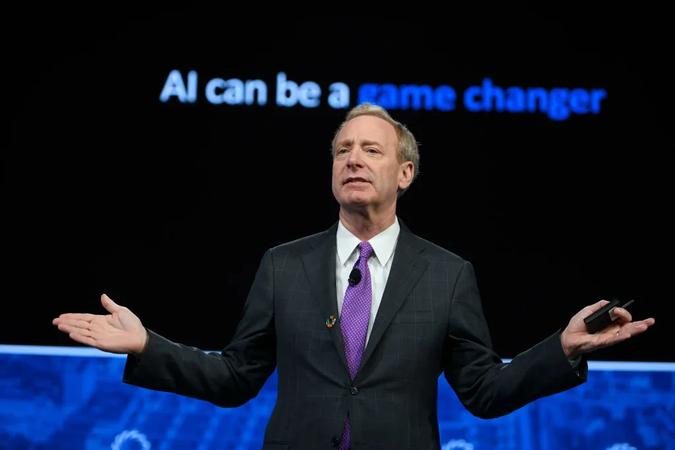
Microsoft President Brad Smith is urging immediate AI regulation, pointing out that everyday consumer goods like milk and washing machines are subject to far stricter oversight than the companies developing artificial intelligence. Speaking on a recent BBC podcast, Smith described AI as both a "weapon and a tool" that poses serious risks to global cybersecurity, and declared that the "moment has arrived" for establishing international safety standards.
Smith further argued that the U.K.—rather than the U.S. or the European Union—is in the best position to take the lead on global AI safety rules. Britain's AI Security Institute, established in 2023, gets early access to major models from U.S. frontier labs before they are released and has rapidly emerged as a frontrunner in AI safety testing. However, that role has recently come under pressure, with U.S. President Donald Trump warning against "globalist" organizations that he says are meddling with American companies. Last month, he reportedly requested that Anthropic and OpenAI hold back new models from British testers, though AISI confirmed on Monday that it can still access and test the newest models.
Despite the president's resistance, Smith contended that the U.K. is capable of regulating AI in ways the U.S. cannot. "In Washington, D.C., people don't look at the U.K. and they don't look at London the way they look at Brussels," he told the BBC. "That's a strength."
His remarks come as tech leaders—including Anthropic's Dario Amodei and OpenAI's Sam Altman—have issued urgent calls to slow AI development following a series of incidents in which AI agents behaved unpredictably. Last month, Trump gathered tech executives from companies such as OpenAI, Anthropic, Nvidia, AMD, SpaceX, Meta, and Google at the White House to discuss AI safety. They signed a "morally binding" document agreeing to collaborate with "independent auditors" to evaluate the safety and capabilities of their AI models.
Smith called the document a "good step," but noted it falls short of the regulation he believes is needed. The flaw with voluntary self-regulation, he explained, is that the "good companies" will follow through. "It's the companies that are not as responsible that you need to worry about," he said.
Smith laid out several AI safety measures he would like to see implemented, including a legal requirement to notify an organization if its system is compromised by rogue AI agents. He also signaled support for requiring AI labs to obtain approval from outside evaluators before releasing an AI product, and spoke favorably about kill-switches that could pause or slow down AI if humans lose control of it.
"Let's speak calmly, maybe even softly, but firmly, and start to bring people together," Smith said. "I hope that's the role we can play as a company. I hope that's the role the U.K. can play as a country."
RELATED ARTICLES


Comments
Please log in to leave a comment.
No comments yet. Be the first to comment!