Nvidia Launches Alpamayo: Open-Source AI Models to Power Autonomous Vehicle Reasoning
By admin | Jan 05, 2026 | 2 min read
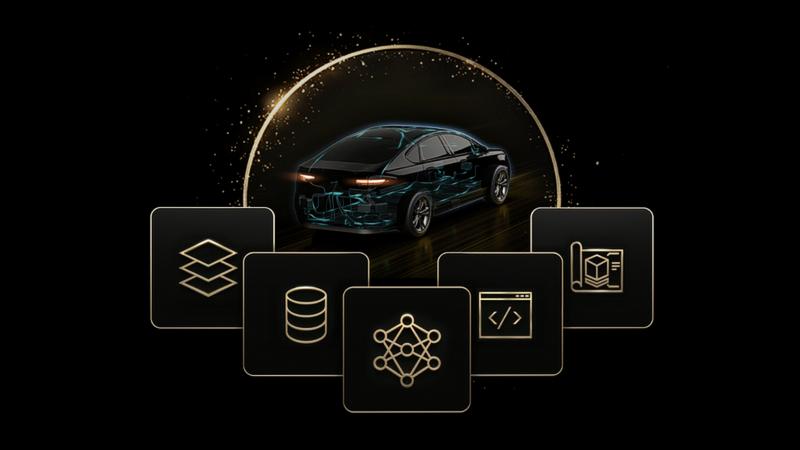
At the CES 2026 event, Nvidia introduced Alpamayo, a new suite of open-source AI models, simulation tools, and datasets aimed at training physical robots and vehicles. This initiative is intended to advance autonomous vehicles' ability to navigate intricate driving scenarios. "We are witnessing the ChatGPT moment for physical AI—where machines start to comprehend, reason, and interact with the physical environment," stated Nvidia CEO Jensen Huang. "Alpamayo equips autonomous vehicles with reasoning capabilities, enabling them to analyze uncommon situations, operate safely in challenging settings, and clarify their driving choices."
Central to this new family is Alpamayo 1, a 10-billion-parameter vision language action model that employs chain-of-thought reasoning. This design allows autonomous vehicles to mimic human-like problem-solving, tackling complex edge cases—such as managing a traffic light failure at a crowded intersection—without prior exposure. "It achieves this by deconstructing problems into sequential steps, evaluating all potential outcomes, and choosing the safest route," explained Ali Kani, Nvidia's vice president of automotive, during a press briefing. Huang elaborated in his keynote, noting that Alpamayo not only processes sensor data to control steering, braking, and acceleration but also reasons about upcoming actions, communicates those decisions, and outlines the resulting trajectory.
The foundational code for Alpamayo 1 is accessible on Hugging Face. Developers can adapt Alpamayo into more compact, efficient versions for vehicle development, apply it to train basic driving systems, or create supplementary tools like auto-labeling systems for video data or evaluators to assess decision quality. "They can also leverage Cosmos to produce synthetic data, then train and test their Alpamayo-based autonomous vehicle applications using a blend of real and synthetic datasets," Kani added. Cosmos refers to Nvidia's generative world models, which simulate physical environments to enable predictions and actions.
As part of the Alpamayo release, Nvidia is providing an open dataset with over 1,700 hours of driving data gathered across diverse locations and conditions, including rare and complex real-world events. The company is also launching AlpaSim, an open-source simulation framework for validating autonomous driving systems. Hosted on GitHub, AlpaSim replicates real-world driving conditions—from sensor inputs to traffic dynamics—allowing developers to conduct safe, large-scale testing.
RELATED ARTICLES



Comments
Please log in to leave a comment.

No comments yet. Be the first to comment!