Nvidia Unveils DLSS 5: AI-Powered Graphics Tech for Hyper-Realistic Gaming
By admin | Mar 16, 2026 | 2 min read
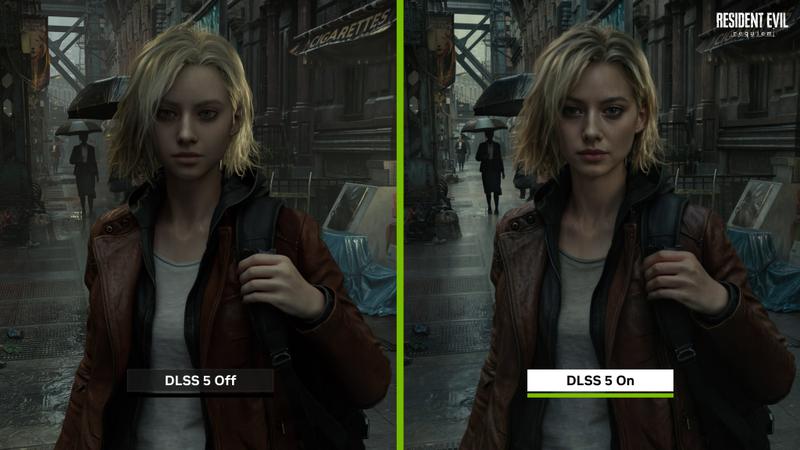
During Monday's keynote at Nvidia GTC, CEO Jensen Huang unveiled DLSS 5, the latest iteration of the company's AI graphics technology. This new system aims to enhance the realism of video games while reducing the computational power required.
EMBED_PLACEHOLDER_0
DLSS 5 merges conventional 3D graphics data with generative AI models capable of predicting and completing portions of an image. This fusion enables Nvidia's GPUs to generate intricate scenes and realistic characters without the need to render every single element from the ground up.
"We fused controllable 3D graphics, the ground truth of virtual worlds, the structured data…with generative AI, probabilistic computing," Huang explained in his presentation. "One of them is completely predictive, the other one is probabilistic yet highly realistic."
He emphasized that integrating structured data with generative AI empowers developers to produce content that is both "beautiful, amazing, as well as controllable."
Huang further suggested that this principle of blending structured information with generative AI will become a recurring theme across numerous industries. "This concept of fusing structured information and generative AI will repeat itself in one industry after another," he stated. "Structured data is the foundation of trustworthy AI."
While gaming now contributes a smaller share to Nvidia's overall revenue compared to its historical significance—despite being the foundation of the company's success—Huang positioned DLSS 5 as indicative of a wider computational evolution. He proposed that this methodology could have applications extending well beyond gaming, even into enterprise computing.
The executive highlighted enterprise data platforms like Snowflake, Databricks, and BigQuery as examples of structured datasets. He envisions future AI systems analyzing these platforms to derive insights. "In the future, what’s going to happen is these data structures are going to be used by AI, and AI is going to be much, much faster than us," Huang said. "Future agents are going to use structured databases as well as the unstructured database, the generative database. This database represents the vast majority of the world."
RELATED ARTICLES



Comments
Please log in to leave a comment.

No comments yet. Be the first to comment!