OpenAI Launches Prism: Free AI-Powered Research Tool for Scientific Papers
By admin | Jan 27, 2026 | 2 min read
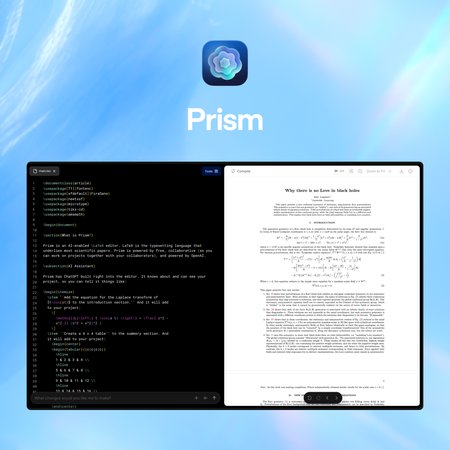
On Tuesday, OpenAI introduced a new free scientific workspace program named Prism, accessible to all ChatGPT account holders. Functioning as an AI-enhanced word processor and research tool for scientific papers, Prism is deeply integrated with GPT-5.2, enabling users to evaluate claims, refine text, and search for existing studies. While not intended for fully autonomous research, company executives anticipate that Prism will significantly speed up the work of human scientists, drawing a parallel to coding interfaces such as Cursor and Windsurf.
Kevin Weill, Vice President of OpenAI for Science, highlighted the tool’s potential during its announcement, stating, “I think 2026 will be for AI and science what 2025 was for AI and software engineering.” This launch coincides with a notable increase in scientific inquiries directed toward OpenAI’s consumer products like ChatGPT. The company reports that ChatGPT receives an average of 8.4 million messages weekly on advanced topics in the hard sciences, though the proportion from professional researchers remains unclear.
AI-assisted research is gaining traction in academic circles. In mathematics, AI models have contributed to solving several long-standing Erdos problems by reviewing literature and applying existing techniques in novel ways. Although the importance of these proofs is still debated, they represent an early success for advocates of AI models and formal verification systems. For instance, a statistics paper published in December utilized GPT-5.2 Pro to develop new proofs for a central axiom of statistical theory, with human researchers primarily guiding and verifying the model’s output.
OpenAI celebrated this achievement in a blog post, framing it as a blueprint for future human-AI collaboration in research. The post noted, “In domains with axiomatic theoretical foundations, frontier models can help explore proofs, test hypotheses, and identify connections that might otherwise take substantial human effort to uncover.”
A key aspect of OpenAI’s new system lies in its practical enhancements to existing standards. Prism integrates with LaTeX, the open-source system for formatting scientific papers, but extends far beyond typical LaTeX tools. Additionally, it employs GPT-5.2’s visual capabilities to let researchers create diagrams from online whiteboard sketches—addressing a common challenge with current software.
Perhaps its most impactful feature merges standard AI capabilities with advanced context management. When users open a ChatGPT window within Prism, the model can access the complete context of the research project, leading to more relevant and insightful responses. While adept users of GPT-5.2 might achieve similar results independently, OpenAI aims to attract scientific researchers more rapidly with a streamlined interface.
Weill likened this approach to the factors that propelled AI tools in software engineering, explaining to reporters, “Software engineering accelerated in part because of amazing models, and in part because of deep workflow integration.”
RELATED ARTICLES



Comments
Please log in to leave a comment.

No comments yet. Be the first to comment!