Cyborg Plant Technology Launches: How Bio-Hybrid Houseplants Could Revolutionize Smart Homes
By admin | Oct 20, 2026 | 5 min read
Justin Mast's life took a dramatic turn thanks to a cyborg plant. Several years ago, while browsing scientific literature, Mast came across research describing a houseplant connected to a motorized stand. When the plant needed more light, electrical signals traveled through its living tissues. A control board detected the current and moved the plant closer to the light source. "I'm like, what the heck," Mast recalled. "That was the entry to the rabbit hole for me."
Mast eventually teamed up with Lee von Kraus, a neuroscientist who has worked with DARPA, to establish Electric Plant. For the past three years, the company has been gathering data to develop a large language model called Bombadil, designed to interpret the subtle electrical signals running through a plant's stem and communicate details about the plant's needs to growers.

The founders envision their model eventually leading to a tool that would allow people to "speak" with plants. "We're listening more than we're speaking, but listening's the first step," said Mast, co-founder and CEO of Electric Plant. To bring its sensors and Bombadil to market, Electric Plant recently secured an $11.2 million seed round led by Onto Ventures and Climactic, with participation from Ponderosa, Endeavor Catalyst, Ludlow, Michigan Rise, The Fund, Schox VC, and Dug Song.
Even in the most controlled greenhouses, farmers and growers lack complete visibility into what their plants require, Mast noted. Traditionally, farmers, growers, and foresters have depended on coarse tools that respond to plants' demands for water, nutrients, or light. While tools like soil probes, handheld spectroscopes, and satellite imagery function adequately, they leave much to be desired, according to Mast. "That technology is sophisticated, but its ability to get at the inside of the plant isn't very sophisticated. Most of that stuff still lags quite a bit behind the real-time needs of the plant," he said.
Electric Plant had to begin somewhere, so it used those devices to train its Bombadil model, which can interpret electrical signals in approximately 125 different species. "We know the model will surpass a lot of that equipment," Mast said. The startup's sensors are also considerably cheaper than existing tools, which typically cost thousands of dollars. "This is tens of dollars," he said.
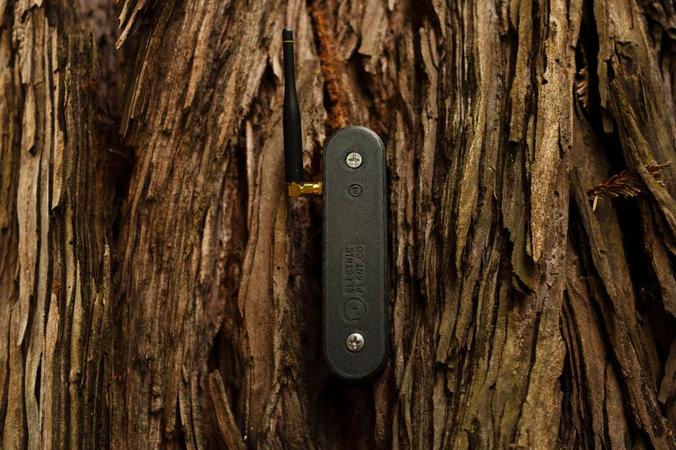
The sensors, roughly the size of a regular iPhone folded lengthwise, are attached to a plant using stainless steel screws. The screws must penetrate the cambium—the layer of living tissue just beneath the bark—to connect to the microvolt changes occurring within the plant. Data collected from these sensors is transmitted to a base station via a low-power wireless network. Electric Plant only requires a couple of sensors per acre for accurate results, Mast said. The data is interpreted by Bombadil in the cloud, and the results are sent back to the customer, who can use them to, for example, adjust their watering or fertilizer schedules. Mast claims such a system can boost yields while reducing water use by 20% or more.
Mast declined to disclose who Electric Plant's initial customers are, but applications in agriculture and forestry are easy to imagine. Bombadil's first hundred-plus species span the range of plant forms, from ferns, redwoods, and tomatoes to dahlias, Mast said. "This is the most diverse model ever created on biological electrical signals," he said. "No one's ever done anything equivalent to this in the animal world."
RELATED ARTICLES



Comments
Please log in to leave a comment.

No comments yet. Be the first to comment!