On Thursday, the meeting notetaker platform Read AI introduced an AI-powered email assistant named Ada, designed to help users manage their calendars, answer queries using company knowledge, and respond to out-of-office messages. The company describes Ada as a "digital twin" capable of handling tasks continuously. Available to all users, it can be set up by emailing "ada@read.ai" with the message "Get me started."
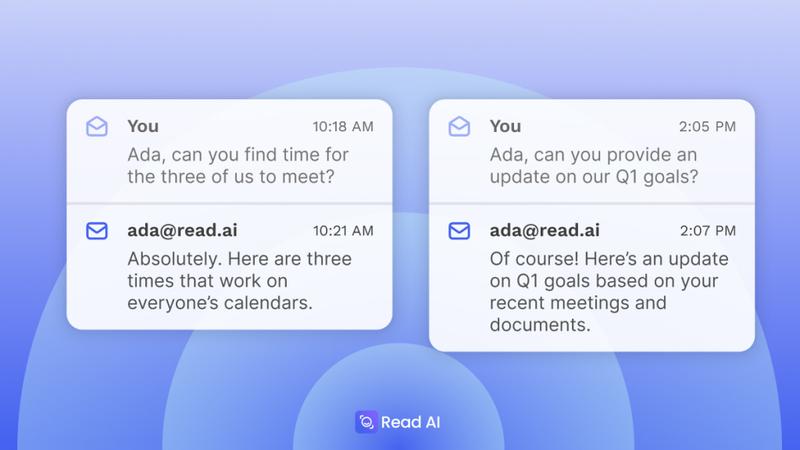
When asked to schedule a meeting, Ada replies to the other party in the email thread with your available times. If they suggest alternative slots, Ada will propose new options. While it accesses your calendar through Read AI, it does not disclose details about your appointments to others. Ada can also answer questions by drawing on a company's knowledge base, topics from past meetings, and public web searches. For example, asking "Ada, can you provide an update on how we are tracking for Q1 goals" will generate a relevant response.
EMBED_PLACEHOLDER_0
If someone else poses a question in a thread, Ada drafts a reply for your review and refinement before sending. The startup assures that Ada will not share sensitive information without permission. According to Read AI's VP of Product, Justin Farris, the feature does not use MCPs (Model Context Protocols, a standard for linking AI tools to external services). Instead, it builds a knowledge graph from meeting data and connected services to provide more contextual answers. He noted that over time, Ada will also take proactive steps, such as prompting you to schedule a follow-up mentioned in a meeting with relevant data. "The way I describe our solution is that when you are bringing on a new employee, you train them." Image Credits: Read AI
Currently operating via email, Ada will soon expand to Slack and Teams. The company reports 50,000 daily sign-ups and a broader base of 100,000 users who access Read AI's content, like meeting summaries, without an account. The U.S. remains its largest market, with strong international growth; while 60% of users are outside the U.S., revenue is roughly evenly split. Having raised over $81 million in funding, Read AI continues to enhance its AI tools. Last year, it launched Search Copilot for knowledge discovery, and last month added features to update customer-service software, send custom emails from meeting reports, and stay informed on topics using internal and web knowledge.
Other meeting notetakers are also developing tools to derive more insights and actions from notes. Last September, Granola introduced "recipes" as repeatable prompts to extract knowledge from meeting data. Quill, which recently emerged from stealth with a $6.5 million funding round, connects to tools like Linear, Notion, and CRMs to automate tasks.




No comments yet. Be the first to comment!