Unitree Robotics Crashes 50% After $66B IPO: Physical AI Bubble Fears Emerge
By admin | Aug 26, 2026 | 5 min read
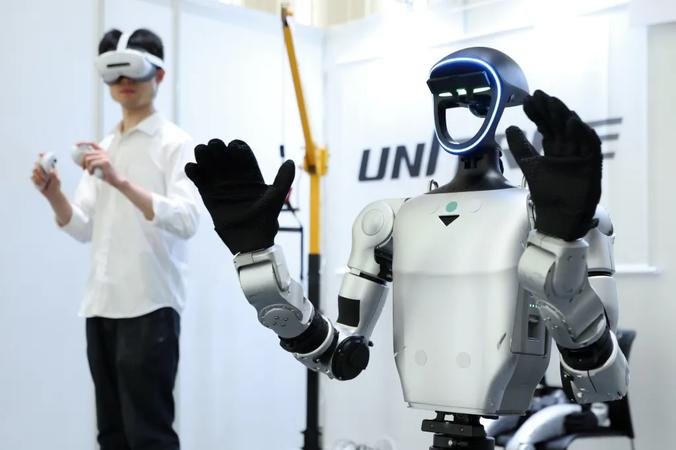
Physical AI has become one of the most buzzed-about areas in venture capital, with startups pulling in billions to bring the technology behind Large Language Models into the world of robotics. This wave of enthusiasm recently propelled Unitree, China's top robot manufacturer, to a massive IPO, valuing the company at $66 billion after it listed on the country's equivalent of the NASDAQ. But this week, the momentum took a sharp hit as the company's stock plummeted, wiping out nearly half its market value. Analysts point to a clear culprit: while these robots are getting better at moving and sensing, they still lack the practical skills needed to perform tasks that actually create value.
At last week's Actuate conference, a gathering focused on building the AI "brains" for robots, optimism was running high. The event has grown threefold since its debut in 2023, drawing 1,500 attendees, according to organizer Foxglove, a company that helps physical AI developers manage and visualize their data. Yet the challenges were just as visible. A booth for Avala, another player in the physical AI infrastructure space, displayed a sign promising to solve "the robotics data crisis."
That crisis boils down to a shortage of high-quality training data for AI models. Building generalized robots that can handle any task remains a distant goal, and even end-to-end learning for specific jobs hasn't produced products with dependable, commercial-grade performance. For developers, the path forward mirrors what frontier AI labs have done: gather or generate more diverse datasets, experiment with different training approaches, and refine reinforcement learning techniques. Harry Mellsop, co-founder of Antioch, a startup creating simulation tools for model builders, compares physical AI's current state to the "GPT 2 era"—the OpenAI model that preceded ChatGPT. Overcoming this hurdle will require more data and computing power, especially GPUs optimized for ray tracing to create high-fidelity simulations.
Autonomous vehicles are leading the pack, partly because they can collect real-world data from human-driven cars and partly because their primary goal is avoiding collisions rather than manipulating physical objects. Much of the tooling for model-building actually traces back to AV companies; Foxglove, for instance, was started by former employees of Cruise, General Motors' now-defunct self-driving project. Increasingly, these car companies are betting that their investments in machine learning infrastructure will let them compete with dedicated humanoid robot makers. Tesla is already testing this approach with its Optimus robot, and both AV-focused Wayve and ride-hailing giant Uber have launched robotics labs centered on humanoid designs as research initiatives. "The data infrastructure, the simulation, ML ops infrastructure, will probably be shared, but the specific world model for the simulator will be a different post-training," one observer noted. "There's going to be a lot more commonality than not, but then there's going to need to be some differences for different embodiments."
Kendall argues it's premature to lock in on any single hardware platform, since advances in sensors and other components are arriving quickly, and a truly general model should stay more flexible across different systems.
Gervet also raised another pressing question in the field: how to focus a physical AI business. Companies targeting specific tasks are already getting robots into the field—Gritt is building solar farms, Agility is deploying robots in industrial settings, and Bedrock is running excavators autonomously. In contrast, general-purpose humanoids are still stuck in the lab. "No customer cares about the general purpose robot that works at 80% success rate," Gervet said, highlighting the dilemma. "We see a lot of other players go general, but there is no value provided because there's no vertical focus. But then, if you're building [for a narrow] vertical on top of GPT 2, you're going to get crushed by the company building on GPT 4."
Still, the pull to invest in a specific vertical is strong, because it offers not just revenue but also real-world deployment data. While task-specific data may lack the diversity needed to advance general models, it's crucial for creating robots that deliver tangible value. Bedrock CTO Kevin Peterson explained that his company started with excavation to grasp the challenges of "manipulation in the wild," but aims to build an intelligence layer that spans a range of construction machinery. Managing all that data is tough, especially given the sheer volume of visual and lidar information. This week, Foxglove introduced a new product built on Nvidia's Cosmos open-weight world model that lets engineers search that data using natural language queries to develop evaluations and simulations. The goal is faster triage and debugging so model builders can iterate more quickly.
So what will be the long-awaited "ChatGPT moment" for physical AI—something Sam Altman recently predicted is just a few years off? Kendall points out that the largest robot deployment worldwide is still consumer vacuum bots. For him, a true breakthrough would be something that excites everyday people, not just investors, who already seem plenty enthusiastic. "One example of that would be when you get eyes-off autonomy for less than $1000 [worth of hardware] in a car," Kendall says; not coincidentally, his company is licensing models to automakers to make that a reality. He sees this as a multi-billion dollar opportunity that could fund the development of a genuinely general embodied AI model. For Gervet, the moment physical AI becomes real is "manipulation that just works out of the box. You can talk to a robot in natural language and have it do any basic task for manipulation, like say pushing, pulling, closing a laptop, cleaning up a table, whatever you want to do, and it works to some level of reliability, let's say 80% plus out of the box—that's roughly your ChatGPT experience."
Adrian Macneil, Foxglove's CEO, views the question from a different angle. "The thing that made ChatGPT a moment in time was the distribution—they went from zero to like a million active users in like a week…distribution in the real world is way harder than that, right. I would be very excited for the Apple II moment in robotics or the IBM PC moment in robotics. When can I buy like a home robot that is gonna start doing some useful and fun stuff."
RELATED ARTICLES


Comments
Please log in to leave a comment.

No comments yet. Be the first to comment!