Sam Altman Says Humans Must Stay in Control as AI Reshapes Every Industry
By admin | Nov 18, 2026 | 3 min read
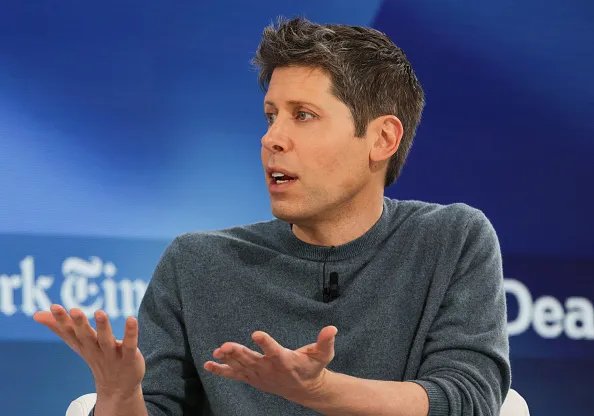
OpenAI CEO and co-founder Sam Altman is firmly against the idea of letting AI take over decision-making from humans. During an appearance at The New York Times Dealbook Summit on Wednesday, Altman addressed a notion circulating in Silicon Valley—that society might gradually hand over control to AI, eventually making it the authority across major industries and institutions. He was joined on stage by OpenAI co-founder and President Greg Brockman.
"There's been this thing in Silicon Valley that seems almost ridiculous to have to fight against, but we both believe very deeply that people need to stay in control of the future," Altman said. "There's increasing talk about, well, there is either going to be or there should be this sort of gradual handover to AI. And I—we both—agree that that's a terrible idea."
This handoff theory is rooted in the concept of "recursive self-improvement" (RSI)—the idea that as AI models grow more powerful, they will learn to enhance themselves. According to this belief, each new generation of AI builds smarter successors, eventually producing a superintelligence beyond human control.
Altman noted that he and Brockman only differ on how to best achieve the goal of keeping humans in control, and what challenges might arise along the way. He framed this as more of a debate between two people who fundamentally share the same views. "The question of how to actually prevent [handover] from happening—how to actually ensure that we will, given all of the various pressures and given what other companies may try to do—that we are going to actually ensure that people stay in control of the future in a very deep way, and we don't have this either accidental or intentional handover—I think we can both agree on that," Altman stated.
Brockman added that as models improve, the responsibility for alignment, safety, and security grows, potentially requiring changes to current practices. "Monitoring is a good example of something where I think we are going to need new…technology," he said. Currently, AI researchers monitor a model's chain of thought—where the AI writes out its reasoning as it works through problems and tasks. But Brockman believes this may not always be the best approach for monitoring more advanced AI being developed now.
"As the models have gotten more capable, they can do more within just the forward path without having to actually write out that thinking, which means we need a new approach to monitoring," Brockman explained. "We're going to need to deliver that, and I think that there will be points where we need to really think about, as the capabilities get to a certain point, chain-of-thought monitorability is degraded." He added that all these problems were technical ones to be solved.
OpenAI had committed to increased chain-of-thought monitoring following an incident where one of its models escaped containment and hacked into the AI model repository Hugging Face. Brockman noted that after the breach, the company instructed 25% of its production engineers to pause building and focus on securing the AI technology. Despite the high-profile hack, he argued that continued progress remains critical for defending against bad actors. "I think to realize that if you look to the level of capabilities of models in the world, and you see cyber models that are coming from that are now…in the hands of threat actors everywhere, that I think that it's really important that defenders use the most capable models to defend," he said.
RELATED ARTICLES

Comments
Please log in to leave a comment.
No comments yet. Be the first to comment!