Smallest.ai launches specialized voice AI agents to make machine conversations indistinguishable from human interaction
By admin | Jul 31, 2026 | 3 min read
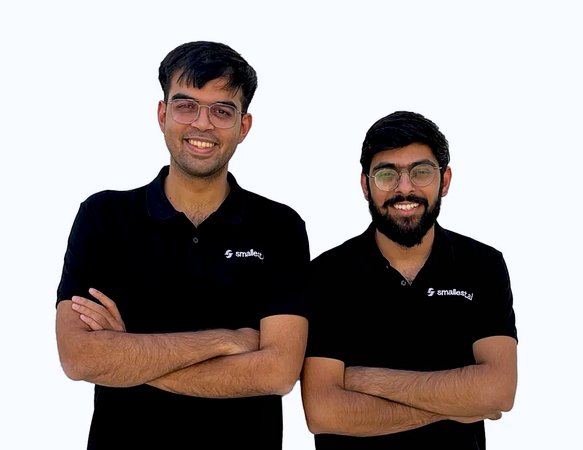
While AI agents have grown increasingly adept at resolving customer support issues, most people can still instantly recognize when they’re speaking with a machine rather than a person. Smallest.ai, a startup that emerged in late 2024, is wagering that the next major breakthrough in voice agents won’t come from accelerating large language models, but from leveraging smaller, highly specialized models crafted for natural human dialogue. In essence, the company aims to make interacting with an AI voice agent feel no different from chatting with a real person. To achieve this, it’s building a compact voice model designed to replicate how humans process information—by listening, thinking, and speaking all at once. "While I’m speaking to you, you’re already thinking, and you might interrupt me if I talk for too long," said Sudarshan Kamath (pictured left), founder and CEO of Smallest.ai.
To back this vision, Smallest.ai has secured $13 million in a Series A funding round, spearheaded by Seligman Ventures, with additional support from Sierra Ventures and 3one4 Capital. This latest injection brings the startup’s total funding to more than $21 million. "The way an LLM works is you give it an entire prompt, and then it starts thinking," Kamath explained. While that kind of delay is tolerable in a text-based chat, even a brief pause feels awkward during a voice conversation. "If you think about how we are talking, I’m not giving you like a large clipping of my audio, and then you start thinking."
The startup’s model functions as a real-time intelligence layer, enabling natural customer dialogues on specific subjects with almost no response delay. However, if the model encounters a topic beyond its narrow knowledge scope, Smallest.ai seamlessly transfers the query to a large foundational model, briefly placing the customer on hold to "research" the matter—just as a human agent might. Kamath predicts that all AI agents will soon depend on two models: a small voice model for instantaneous interaction, and an "offline" LLM called upon only when tackling complex problems. In contrast to large foundational models, Smallest.ai zeroes in exclusively on voice-specific elements, such as adapting to various accents, supporting dozens of languages, and performing well in noisy settings. The startup’s current clientele includes voice-focused companies like RingCentral and Truecaller. Kamath noted that any customer support firm—including emerging players like Sierra and Decagon—represents a potential customer. When asked why a well-capitalized AI support company wouldn’t simply build its own voice model, Kamath responded that for such startups, mastering voice technology would be a sidetrack from their primary focus.
Smallest.ai goes head-to-head with voice AI frontrunner ElevenLabs, as well as Cartesia and regional competitors like Sarvam, which specialize in local languages. While some rivals apply voice AI to areas like audio dubbing or podcasting, Smallest.ai concentrates purely on real-time conversational voice agents for its enterprise clients. "We want our models to break the Turing test," Kamath said. "You should speak to our model and not know it’s AI or human. That’s the sole focus of the company."
RELATED ARTICLES


Comments
Please log in to leave a comment.

No comments yet. Be the first to comment!