Sophia Space Secures $10 Million to Cool High-Powered Space Processors
By admin | Feb 26, 2026 | 2 min read
As space firms seek to deploy cutting-edge chips in orbit, effectively cooling these high-performance processors has become a critical challenge. "It’s cold in space…[but] there’s no airflow, and so the only way to dissipate is through conduction," noted Nvidia CEO Jensen Huang when discussing space-based data centers during his company's latest earnings call. In response to this issue, Sophia Space has secured $10 million in funding from investors such as Alpha Funds, KDDI Green Partners Fund, and Unlock Venture Partners.
The company aims to first validate a novel method for passively cooling space computers in terrestrial testing. Following this, Sophia plans to purchase a satellite bus from Apex Space and demonstrate the technology's functionality in orbit by late 2027 or early 2028. While other players like SpaceX, Google, or Starcloud are exploring conventional satellite designs with large radiators for their planned space data center constellations, Sophia Space's leadership—CTO Leon Alkalai, CEO Rob Demillo, and chief growth officer Brian Monin—is pursuing a distinct path.
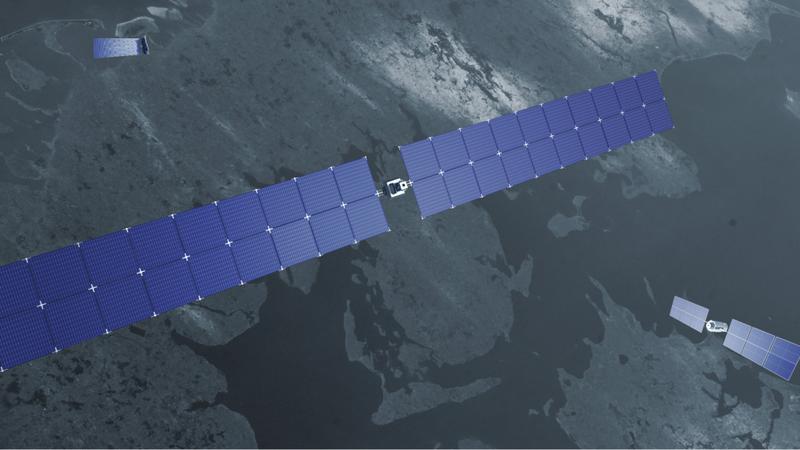
The team has developed a sail-like structure that is notably thin and flexible, contrasting sharply with the bulky, traditional satellite forms. Although generating electricity for Earth use presents technical and regulatory hurdles, Alkalai, who is also a fellow at the Caltech-managed Jet Propulsion Laboratory, was inspired to adapt this design for powering processors in space. This concept aligns with similar insights from Aetherflux, a startup focused on space-based solar power.
As an Nvidia partner, Sophia has created modular server racks equipped with integrated solar panels, named TILES. Each TILE measures one meter by one meter in area and is only a few centimeters thick. According to Demillo, this slim profile allows processors to be placed directly against a passive heat spreader, removing the need for active cooling systems. He anticipates that 92% of the generated power will be dedicated to processing, marking a substantial improvement over traditional architectures.
Achieving this efficiency, however, depends on advanced software to manage and balance workloads across the processors. Looking ahead to the 2030s, Sophia envisions constructing larger space data centers composed of thousands of interconnected TILES. These could form structures as large as 50 meters by 50 meters, capable of delivering one megawatt of computing power.
Demillo emphasizes that approaches using less efficient systems would not be economically viable for space data centers. He also believes that a single, integrated structure will be more practical to implement than a distributed network connected by lasers. Initially, though, Sophia intends to offer its TILE technology to satellite operators who need computing capabilities in orbit.
Potential early adopters could include earth observation satellites that gather vast amounts of sensor data, missile warning and tracking systems receiving billions in Pentagon investment, or the increasingly sophisticated networks used for communications.
RELATED ARTICLES


Comments
Please log in to leave a comment.

No comments yet. Be the first to comment!