Optical Transceiver Startup Mesh Optical Raises $50M Series A Led by Thrive Capital
By admin | Feb 17, 2026 | 2 min read
Travis Brashears, Cameron Ramos, and Serena Grown-Haeberli first worked together at SpaceX, where they developed optical communication systems to maintain constant contact with thousands of Starlink internet satellites. Today, the three engineers are the co-founders of Mesh Optical Technologies, a Los Angeles-based startup that recently announced a $50 million Series A funding round led by Thrive Capital.
Mesh focuses on the mass production of optical transceivers—devices that convert optical signals from fiber or lasers into electrical signals for computers. CEO Brashears, President Ramos, and VP of Product Grown-Haeberli identified this opportunity while designing a new generation of compute-intensive SpaceX satellites, which led them to evaluate the optical transceiver market and recognize its existing limitations.
These components are especially critical for data centers that train and operate large deep learning models, as they enable multiple GPUs to work together efficiently. Last year, an established U.S. supplier, AOI, secured a $4 billion contract to provide components for AWS data centers. As Brashears noted, “Someone will brag about a million GPU cluster; you have to multiply by four to five for the number of transceivers in that cluster.”
Mesh aims to produce a thousand units daily within the year, positioning the company to qualify for bulk orders by 2027 or 2028. Currently, the optical transceiver market is dominated by Chinese firms, and Mesh believes there is a strategic advantage in building its supply chain outside of China. Although trade restrictions have not yet affected the market, the founders and their investors view their approach as proactively addressing a potential national security concern. “In the immediate term, Mesh is solving our need for better ways to do interconnect if we want to keep scaling AI.”
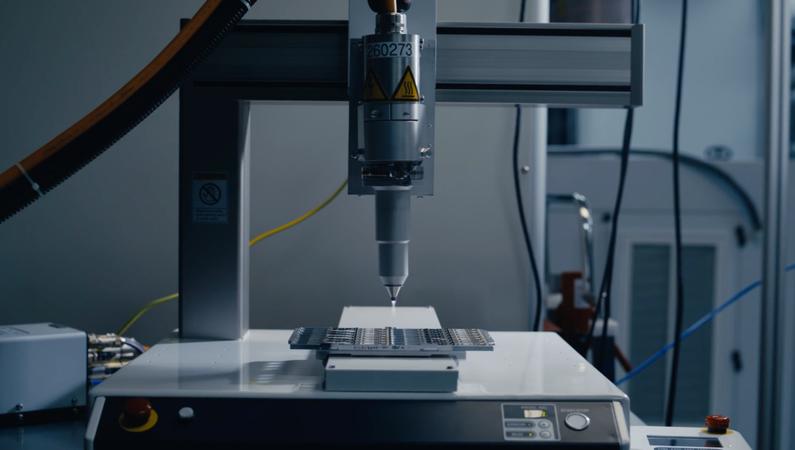
A key challenge for Mesh involves implementing fully automated, lights-out manufacturing techniques, which are not commonly used in U.S. industry. Much of the relevant expertise is concentrated in China—so much so that even some European equipment suppliers design their processes around Chinese clients. One German company’s standard intake form, for example, requests a Chinese company registration number.
By co-locating design and production, the founders aim to create more efficient and cost-effective components. Their current design eliminates a commonly used but power-intensive part, which Ramos stated could reduce GPU cluster power consumption by 3% to 5%—a significant improvement as hyperscalers strive to maximize system efficiency.
Data centers represent just the beginning of Mesh’s ambitions. The company views optical wavelength communication as the next major paradigm in connectivity. “We want to be at the precipice of transition from RF to photonics…we want to interconnect everything, and not just computers, but that’s where we’re starting.”
RELATED ARTICLES



Comments
Please log in to leave a comment.

No comments yet. Be the first to comment!