Local AI Notetaker Talat Launches as Private, One-Time Fee Alternative to Subscription Apps
By admin | Mar 24, 2026 | 3 min read
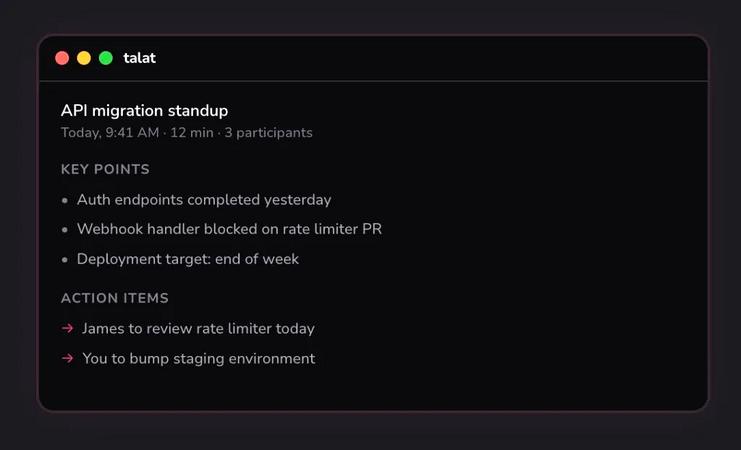
Granola, an AI-powered notetaking app with a $250 million valuation, has gained popularity with tech founders and venture capitalists. However, a developer saw an opportunity for a more private alternative—a local-only application available for a single payment, free from subscriptions. This vision led to the creation of Talat, a new Mac app.
Nick Payne, a developer from Yorkshire, England who describes himself as a computer nerd, explains that the concept for a local AI notetaker emerged from a series of fortunate discoveries. "When I first experimented, I was intrigued that it could capture system audio on my Mac without recording video, which was the common method at the time. That sparked extensive research and led me to a relatively new and poorly-documented Apple API."
EMBED_PLACEHOLDER_0
To simplify working with this API—Core Audio Taps, which allows access to a Mac's audio streams—Payne developed an open-source audio library named AudioTee. "Throughout that period, I was gradually assembling a toolkit, but nothing felt substantial enough to be a standalone product rather than just an impressive technical demonstration," Payne remarked. "The advanced hosted transcription models used by services like Granola are remarkable, and it's thrilling to watch your speech appear onscreen almost instantly. Yet, it always bothered me that the compromise involved sharing not only my data but my actual audio and voice," he added.
He later discovered FluidAudio, a Swift framework that enables fully local, low-latency audio AI on Apple devices. This toolkit allows small, fast transcription models to run directly on the Mac's Neural Engine—Apple's specialized hardware for AI tasks. This breakthrough made Payne realize he could transform his research into a tangible product where audio never leaves the user's Mac and transcripts aren't stored on external servers.
Talat is the outcome of Payne's exploration into audio technology, developed alongside his longtime friend and former colleague, Mike Franklin. The final product is a compact 20 MB application available for a one-time purchase, requiring no account creation or sharing of analytics data with the developers. There are no recurring fees.
While other AI notetakers may offer more features, Talat focuses on a streamlined set of capabilities. It records audio from your computer's microphone during meetings on platforms like Zoom, Teams, and Google Meet, providing real-time transcription. The app attempts to identify speakers automatically, but users can adjust assignments as needed. Additional functions include taking notes, editing, deleting, or splitting transcript sections. After a meeting concludes, a local LLM generates a summary highlighting key points, decisions, and action items. All notes, transcripts, and summaries are searchable within Talat.
Beyond privacy, Payne emphasizes the goal of offering users greater flexibility. "We're prioritizing configurability and letting users dictate their data flow: choose your own LLM, automatically export to Obsidian, use webhooks to send data post-meeting, or employ an MCP server—a standard for connecting AI tools to external data sources—to retrieve information on demand," he explained.
Technically, the AI integrates various components, "mostly assembled and streamlined through FluidAudio," Payne noted, crediting the framework with handling much of the complex work. For summarization, the app defaults to the Qwen3-4B-4bit AI model, which operates efficiently even on less powerful hardware. Users can optionally switch to any cloud LLM provider, select between two Parakeet variants—speech recognition models from Nvidia—or use Ollama for running AI models locally, offering extensive control over their experience.
Future updates will introduce more built-in options and integrations with apps like Google Calendar and Notion. At launch, users with M-series Macs (starting with M1 models) can download Talat and test it with 10 hours of free recordings before purchasing. The pre-release version, still in active development, is priced at $49. Upon reaching version 1.0, the price will rise to $99.
Payne and Franklin are self-funding Talat and intend to maintain the core product as a one-time purchase.
RELATED ARTICLES

Comments
Please log in to leave a comment.

No comments yet. Be the first to comment!