Trump's Executive Order Challenges State AI Laws, Sparking Legal Uncertainty for Startups
By admin | Dec 13, 2025 | 3 min read
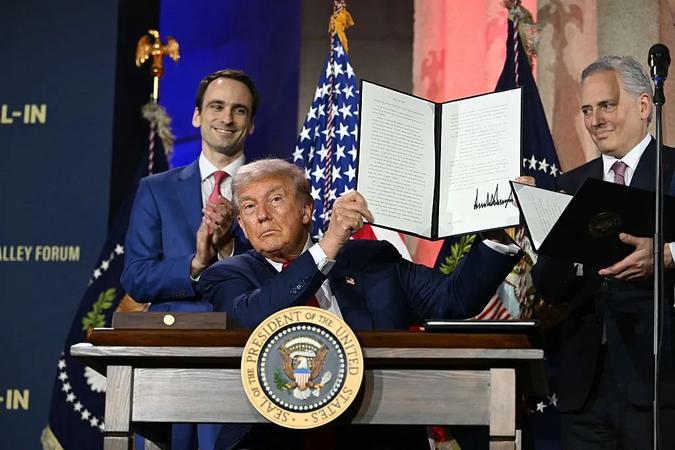
On Thursday evening, President Donald Trump signed an executive order directing federal agencies to contest state-level artificial intelligence regulations, contending that startups require relief from a disjointed "patchwork" of rules. Concurrently, legal experts and startup representatives warn that the order may extend regulatory uncertainty, potentially igniting court battles that force young companies to navigate evolving state requirements while awaiting possible congressional agreement on a unified national framework.
Titled “Ensuring a National Policy Framework for Artificial Intelligence,” the order instructs the Department of Justice to establish a task force within 30 days to challenge specific state laws, asserting that AI constitutes interstate commerce and should fall under federal oversight. It also mandates the Commerce Department to compile, within 90 days, a list of state AI laws deemed "onerous," an evaluation that could influence states' eligibility for federal funding, including broadband grants.
Additionally, the order calls on the Federal Trade Commission and the Federal Communications Commission to examine federal standards that could override state regulations and directs the administration to collaborate with Congress on a uniform AI law. This action occurs amid a wider effort to curb state-by-state AI rules after legislative attempts to pause state regulation stalled in Congress.
Lawmakers from both parties have contended that without a federal standard, preventing states from acting could leave consumers unprotected and companies insufficiently regulated. “This David Sacks-led executive order is a gift for Silicon Valley oligarchs who are using their influence in Washington to shield themselves and their companies from accountability,” stated Michael Kleinman, head of U.S. Policy at the Future of Life Institute, an organization focused on mitigating extreme risks from transformative technologies.
Sacks, who serves as Trump’s AI and crypto policy czar, has been a prominent advocate behind the administration’s push for federal preemption of state AI laws. Even proponents of a national framework acknowledge that the order does not itself create one. With state laws remaining enforceable unless blocked by courts or paused by states, startups could face a prolonged transition period.
Sean Fitzpatrick, CEO of LexisNexis North America, U.K., noted that while supporters argue the order might reduce uncertainty by centralizing AI regulatory disputes in Washington, critics believe the ensuing legal conflicts will create immediate challenges for startups juggling conflicting state and federal demands. “These programs can be expensive and time-consuming to meet a very dynamic regulatory environment,” Fitzpatrick observed.
Arul Nigam, co-founder of Circuit Breaker Labs—a startup that conducts red-teaming for conversational and mental health AI chatbots—shared these concerns. “There’s uncertainty in terms of, do [AI companion and chatbot companies] have to self-regulate. Are there open source standards they should adhere to? Should they continue building?” Nigam expressed hope that Congress can now act more swiftly to pass a robust federal framework.
“The uncertainty does hurt startups the most, especially those that can’t get billions of funding almost at will,” he added, noting that legal ambiguity complicates sales to risk-averse clients such as legal teams, financial firms, and healthcare organizations, lengthening sales cycles and increasing systems work and insurance costs.
Gary Kibel, a partner at Davis + Gilbert, remarked that businesses would welcome a single national standard but cautioned that “an executive order is not necessarily the right vehicle to override laws that states have duly enacted.” He warned that the prevailing uncertainty risks two extremes: overly restrictive regulations or no action at all, either of which could foster a “Wild West” environment that advantages Big Tech’s capacity to absorb risk and wait out developments.
Meanwhile, Morgan Reed, president of The App Association, urged Congress to promptly enact a “comprehensive, targeted, and risk-based national AI framework.” Reed emphasized, “We can’t have a patchwork of state AI laws, and a lengthy court fight over the constitutionality of an Executive Order isn’t any better.”
RELATED ARTICLES



Comments
Please log in to leave a comment.

No comments yet. Be the first to comment!