Anthropic upgrades Claude's voice mode with Opus, Sonnet, and Haiku model support for smarter, more versatile conversations
By admin | Jul 23, 2026 | 5 min read
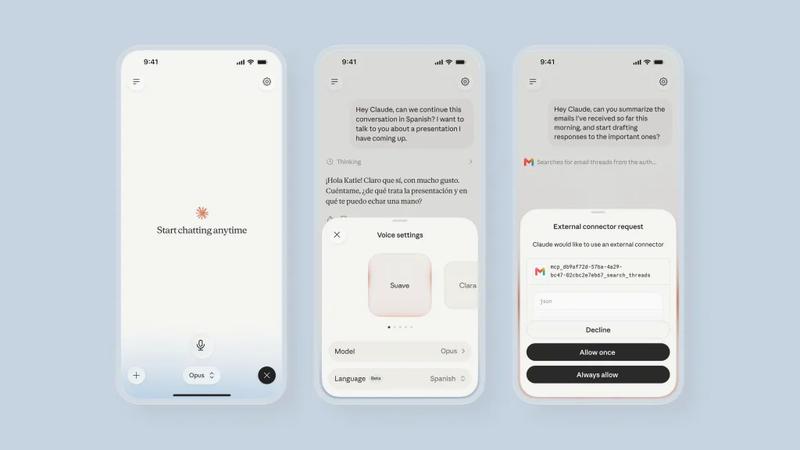
Weeks after OpenAI launched a new series of conversational models and refreshed ChatGPT’s voice mode, competitor Anthropic is rolling out an update to make its Claude assistant more voice-friendly. On Thursday, the company announced that users can now choose between the Opus, Sonnet, and Haiku models. Claude’s voice mode, originally introduced last year and powered by the Haiku model, offered fast responses but struggled with more complex tasks. With this latest update, Anthropic explains that the voice mode will automatically select the last model a user employed in text chat and default to its fastest version. The enhanced voice mode, according to Anthropic, supports longer conversations—helping users refine their communication style, practice pitches for clients, or brainstorm product market research ideas.

Additionally, Claude’s voice mode can now integrate with other applications such as Gmail, Google Calendar, Slack, Canva, and Notion. This allows users to ask it to reschedule a meeting, compose an email, or generate a document in Notion. This capability marks a significant contrast with OpenAI’s voice mode, which updated its conversational style but remains unable to leverage external tools for completing tasks.

Earlier this year, Anthropic introduced multilingual support for Claude’s voice mode in beta. The company states that users can now speak in multiple languages, though they must manually specify which language they are using. Currently, Anthropic supports English, French, German, Hindi, Indonesian, Italian, Japanese, Korean, Portuguese (Brazilian), and Spanish (Latin America/Spain). The new voice mode is available in beta to all users across platforms. However, free users are limited to the Haiku model and can connect only one app at a time. Anthropic did not modify the underlying voice model with this release and has not disclosed the specifics of its voice technology stack. As a result, unlike OpenAI’s update, users may not see improvements in conversational features such as better handling of interruptions.
RELATED ARTICLES


Comments
Please log in to leave a comment.

No comments yet. Be the first to comment!