Eka Robotics Launches Force-Sensitive Gripper and Deep Learning Model, Raises $150M Series A at $1.45B Valuation
By admin | Oct 20, 2026 | 5 min read
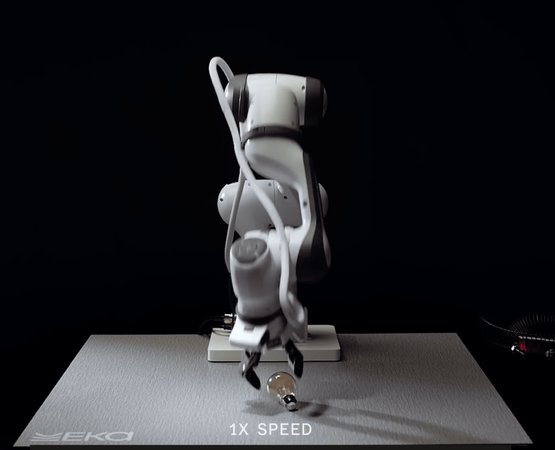
Robots have long struggled with grasping objects—a challenge that has persisted despite billions in investment and countless hours of video fed into deep learning systems. Eka Robotics aims to change that with a manipulation architecture combining a force-sensitive gripper and a novel deep-learning approach. The startup, founded by MIT professor Pulkit Agrawal and former Google DeepMind researcher Tuomas Haarnoja, has just closed a $150 million Series A round led by venture funds a16z and F-Prime, valuing the company at $1.45 billion post-money. In an age where robotic demos are ubiquitous, Eka's capabilities are startling seasoned robot builders. Kris Hauser, a professor at the University of Illinois Urbana-Champaign, described a "wow factor" compared to other recent robot demonstrations he's seen. The Eka robot "was able to adapt to a large number of different objects without retraining," Hauser noted, adding that it exhibited a kind of "humanness, creepy humanness that it would try over and over again if it failed the first time." See for yourself:
EMBED_PLACEHOLDER_0
What stands out here is how smoothly and rapidly the robot moves. It can pick up roughly 1,500 objects weighing up to 1 kg per hour—compared to about 600 for a human—and Eka claims it reliably grasps objects more than 95% of the time. The robot arm is powerful enough to damage itself at that speed, which, according to a frontier lab observer, signals that "they have a lot of trust in their algorithm not breaking the robot. I wonder how many robots they broke along the way." When the frontier lab roboticist encountered Eka's robot, they handed it a raspberry—the lab's apparent favorite test item.
How not to squish the raspberry
These capabilities stem from how the foundational model was constructed. Instead of a vision-language-action model—trained to understand relationships between language, visual inputs, and actions—the framework here is a vision-force-action model, focusing on the relationship between language, force inputs, and actions. Critics of the current direction in generative AI robotics, such as Rodney Brooks, argue that these models will fail without attempting to represent force and touch; Eka's results suggest such critics have a point. "Vision tells you roughly where the object is, what the pose is, but the actual grabbing, the actual searching is happening through forces."
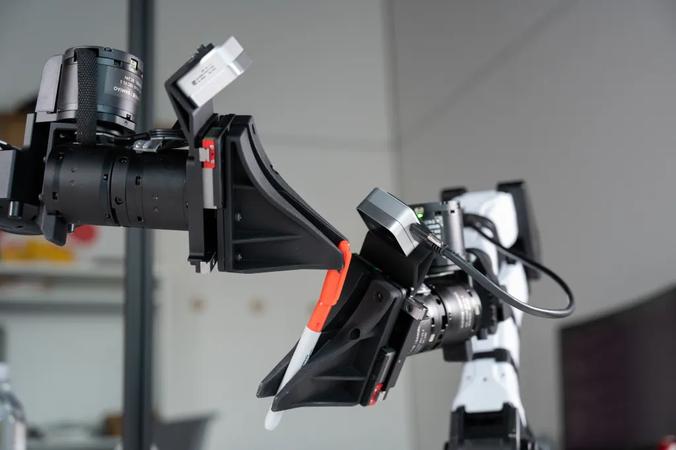
Eka had to design a unique robotic hand more flexible than traditional grippers, equipped with more force sensors; it reacts to contact, which is why it doesn't crush the raspberry. The founders are guarded about how they achieved this for obvious competitive reasons, but it boils down to using a physics simulator to model the multiple forces the robot will encounter while attempting a grasp, and leveraging that to create a reinforcement learning environment that can run at scale. They say they can generate thousands of hours of robot experience in minutes. "Rather than being limited to the data that you're collecting from, say, human demonstrations, Eka is pushing through reinforcement learning this approach where the robot can surpass any kind of demonstrations that are given to it," Hauser said. "What's really exciting is that they're able to not be limited to the data that is presented to them for training."
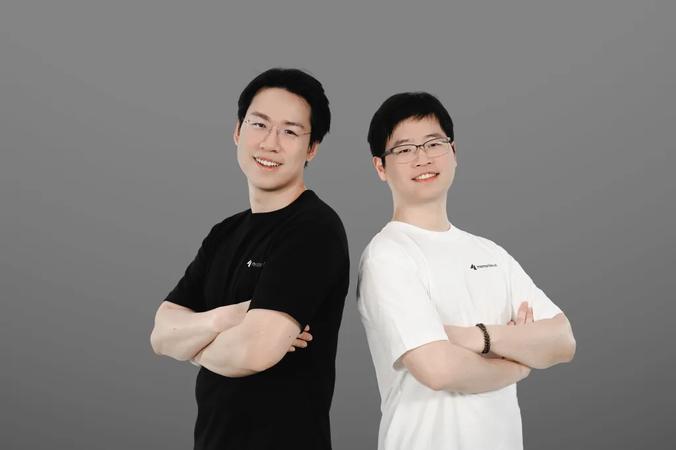
Agrawal and Haarnoja, who first met in graduate school at the University of California, Berkeley, are leading researchers in reinforcement learning for robotics control. Eka's key bet was that this technique could be scaled through simulation rather than relying on videos collected by gig workers or robot operators performing tasks over many hours. Simulation was crucial to achieving their robot's reliable manipulation—a feat that has historically proven more difficult for tasks requiring interaction with objects rather than avoidance. "What EKA is bridging is the generality-performance gap, which plagues a lot of modern robotics," Agrawal argues.
Making a general-purpose robot useful
Currently, the most generalizable physical AI models—those that can attempt many different tasks—aren't particularly good at them. But AI models trained to be highly capable at a single task may not close the business case for a company: The promise of generative AI is that robots can quickly learn multiple tasks, even novel ones. Current approaches are good at producing robots that are more generally intelligent than before—Astra, ChatGPT's latest LLM, can operate a robot in an unfamiliar setting and perform tasks with it, but slowly and at high cost. The promise of a model like Eka's is that it handles the physicality while a more general model makes decisions about how to solve a problem. Astra, for example, might know that plates get stacked in a cupboard when they come out of the dishwasher, but Eka's model is capable of picking up a dish without breaking it. "Most of the field has been focusing on the planning," Eka co-founder Haarnoja says, "so they approach from the top: high-level intelligence, pushing that down towards the physical. Whereas we think about it from the bottom up."
Eka still needs to prove itself in the field, though. The company is working in secretive pilots with a number of industrial customers doing pick-and-place and wire manipulation, but the leap from lab to line is almost as big as the gap between simulation and reality. "What's going to be a big challenge is when they work with integrators on real assembly lines, and it needs to run without breaking for an entire year," Hauser said. The other open question is "how generalizable these techniques can be to different tasks. What I've seen is pick and place, but many industry tasks that are value added involve more than just pick-and-place."
Agrawal is also focused on deployability; right now, he says Eka's gripper hardware—which costs less than $1,000—is rated for 5 million duty cycles, but the ultimate goal is to hit the 20 million cycle bar set by standard industrial arms. "What we are building is that engineering of how to design entire workflows, but we are starting off being very pragmatic, and saying here are two verticals in pick, arrange, place, and wire handling, let's make them be home runs," Agrawal said. "Once we have made home runs on them, the sky is the limit in how much we can do with the approach we are developing."
RELATED ARTICLES
Comments
Please log in to leave a comment.

No comments yet. Be the first to comment!