Nvidia Jetson Chips to Power Lunar Rover's LiDAR in First GPU Mission to the Moon
By admin | Jul 23, 2026 | 3 min read
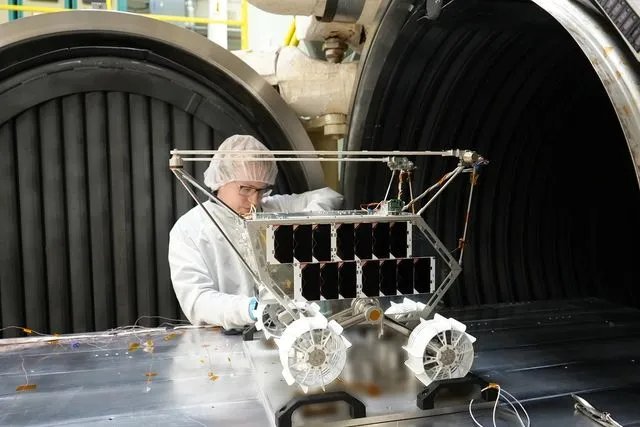
Nvidia’s push to put its GPUs everywhere has a new destination in sight: the Moon. On Thursday, Lunar Outpost—a startup focused on building robotics for space infrastructure—announced that its next lunar rover will rely on Jetson chips to manage its LiDAR system. If successful, this would likely mark the first GPU ever deployed on the Moon’s surface. “We’re taking the NVIDIA Jetson and comparing it to our flight compute platform that has a little bit more spaceflight heritage,” said Lunar Outpost CEO Justin Cyrus. “[We’re] seeing what the pros are, seeing what the cons are. And we’re really pushing towards trying to adopt these more capable GPU-powered systems in these extreme environments.”
NASA has initiated a program to fund private companies for lunar exploration, ahead of plans to send human astronauts back to the Moon, potentially as soon as 2028. Modeled after its collaboration with SpaceX, the agency is asking tech firms to develop vehicles that can carry scientific instruments to the Moon. These missions aim to map the terrain and search for resources like water, which could prove valuable or even profitable to extract. Nvidia also recently teamed up with Firefly Aerospace—the first private company to safely land a robot on the Moon—to operate its Jetson platform on a satellite orbiting the Moon, processing imagery. That satellite will help scientists map the lunar surface while also tracking the increasing number of robots on the ground. Lunar Outpost’s next rover will ride aboard a lander built by Intuitive Machines, another Moon-focused tech company. This rover is designed to transport a suite of sensors into craters and other hard-to-reach areas that orbital scans can’t fully explore. A subsequent mission will target Reiner Gamma, a region on the Moon where a magnetic anomaly has long puzzled researchers. Both missions are expected to launch on a Falcon 9 rocket before the end of the year. While Nvidia’s Jetson platform isn’t as famous as AI powerhouses like Blackwell and Vera Rubin, it plays a crucial role in many physical AI systems. Designed to be compact and energy-efficient, Jetson enables robotic systems to process sensor data locally, helping them understand and react to their surroundings more quickly. “Our autonomy stack was a bit more deterministic five years ago, and now it’s a combination of deterministic and physical AI, which is pretty fun,” Cyrus said. “We still run both in parallel, and then it’s our job to figure out where physical AI can actually plug into our stack and help us do things that no one’s done before.”
EMBED_PLACEHOLDER_0
Using GPUs in space presents significant challenges due to the harsh environment. Most space-faring GPUs operate in low Earth orbit, where they’re relatively shielded from radiation and extreme temperature shifts. The Moon, however, is far more exposed to cosmic radiation and experiences dramatic temperature swings as it cycles through its phases. “Your system has to survive lunar night and has to do so on very low power,” Cyrus explained. If Lunar Outpost’s engineers can make the chips work in that environment, they hope their vehicles will become more capable—able to process surroundings and make decisions faster. NASA envisions a sustained human presence on the Moon, but that likely depends on autonomous systems to pave the way and handle the heavy work. “What we at Lunar Outpost are currently working on is how do we go from exploration to permanence, how do we actually build that outpost on the Moon,” Cyrus said. “We do think combining our deterministic models plus the physical AI layer—that’s what allows us to make a human presence in space sustainable, actually having that robotic workforce.”
In the coming years, Lunar Outpost has several small autonomous rovers scheduled for lunar launches, along with one larger rover called Pegasus, designed to carry astronauts. Pegasus is waiting on a rocket built by Jeff Bezos’ space company, Blue Origin, but that launch vehicle experienced an anomaly this summer, and its return-to-flight timeline remains uncertain. “It does seem like they’re making pretty darn good progress on the pad,” Cyrus noted. “I can’t really answer Blue Origin’s timelines or NASA’s timelines on the pad reconstruction, but everything we’ve been told, we’re on the same timeline [for 2028].” That leaves futuristic visions of space data centers and fleets of robots working on the Moon all waiting on the same thing: a bigger rocket.
RELATED ARTICLES


Comments
Please log in to leave a comment.

No comments yet. Be the first to comment!