Anthropic Launches Claude Cowork on Web and Mobile for Max Subscribers
By admin | Jul 07, 2026 | 3 min read
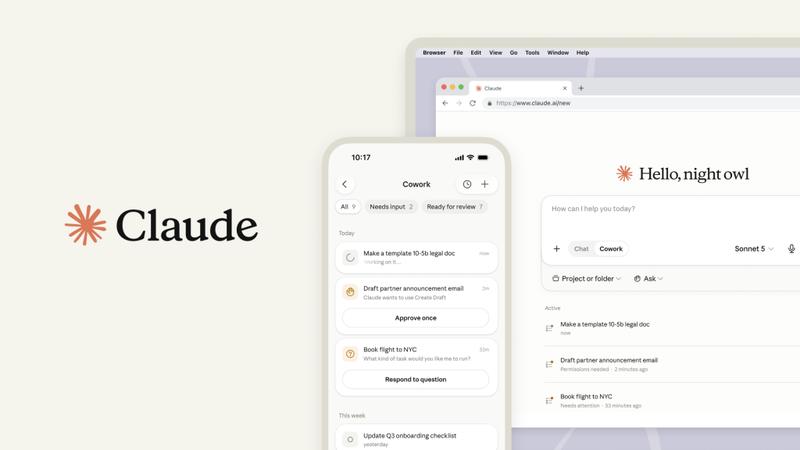
Claude Cowork, Anthropic’s AI agent designed for general knowledge work in the style of Claude Code, is expanding to mobile devices. Initially launched as a desktop application in January, it will become available on web and mobile platforms starting Tuesday for Max subscribers. This update allows users to initiate tasks at their desk, receive status updates on their phone, and retrieve completed work later—even if their laptop is turned off. The move signals Anthropic’s intent for Cowork to evolve beyond a simple coding assistant into a more autonomous administrative partner: one that operates in the background, follows users across devices, and seeks human input only when decisions require personal judgment. In essence, the competition among coding agents is now extending into broader office environments.
This development occurs as AI companies strive to transform their products from basic chatbots into tools integrated into the everyday workflows where actual work happens. OpenAI has pursued a similar path with Codex, which originally focused on software development but is now increasingly used by non-developers for tasks like reports, spreadsheets, presentations, research, and data analysis. For both companies, the underlying bet is that success will hinge less on having the best chatbot and more on owning the space where work is performed. This strategy also involves expanding into other applications. Anthropic recently launched Claude Tag, an always-on version of Claude that resides in Slack and functions as an AI teammate. Beyond the advantages of any single interface, launching Cowork as a multi-platform app allows the agent to continue running tasks in the background without needing a device to remain online, the company explains. One example from Anthropic illustrates this: “Set Monday’s client prep for 6 am: Claude works through the email threads, transcripts, and recent news, builds the briefing doc, and leaves the follow-up email drafted but unsent. Review it over coffee.”
The desktop app will remain the primary environment for deep work, where Claude can access local files and the browser. However, bringing Cowork to web and mobile ensures that people who haven’t installed the app can still use it. Anthropic notes that chat and Cowork will be unified on web and desktop initially, with projects and artifacts coexisting across both platforms. The company also released early usage data for Cowork, indicating that its clearest application is handling the “work around the work” that keeps organizations running—what Anthropic describes as “tasks that are part of a broad swath of jobs, but are rarely a person’s core responsibility.”
The study analyzed 1.2 million anonymized and aggregated Cowork sessions from over 600,000 organizations during the last two weeks of May. The largest category, accounting for 33.4% of usage, was business process operations: compiling scattered updates into a single report, creating onboarding checklists, and reconciling spreadsheets. Anthropic noted that these tasks are common in finance, HR, and administrative roles. The second-largest category, at 16.4%, was content creation and copywriting: activities such as drafting documents, slide decks, social media posts, proposals, and other communications work typically performed by marketing and management positions. In contrast, software development represented only 8.7% of Cowork usage. “While coding is still—understandably—one of the uses of AI that gets the most attention, the use of AI for everyday business work is on the rise, and the kinds of tasks people are finding it most helpful for are coming into focus,” Anthropic stated in a blog post. “Our goal is to make this a reference point for people who are figuring out how to integrate AI products into their daily work, and to show where value is most concentrated.”
RELATED ARTICLES
Comments
Please log in to leave a comment.
No comments yet. Be the first to comment!