Generative AI Menus Are Taking Over Restaurants—Here’s How to Spot the Unsettlingly Perfect Food Photos
By admin | Sep 04, 2026 | 6 min read
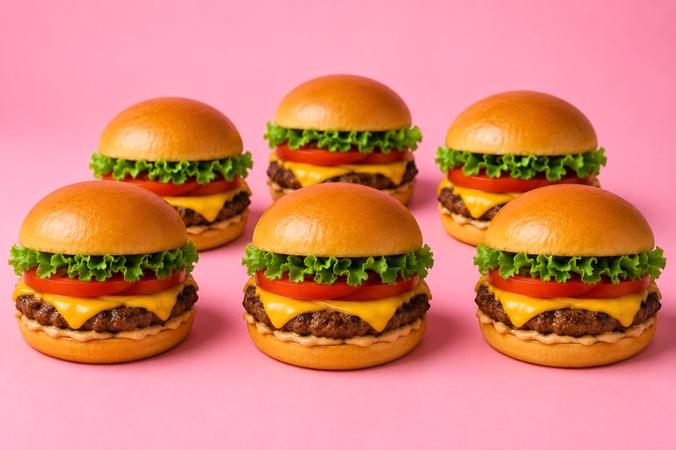
The first time you encounter one, it’s easy to think you’re losing your grip on reality. You step into a café, glance at a menu full of bagel sandwich options, and every single illustration looks suspiciously perfect—flawlessly symmetrical, oddly smooth, and just a little too clean. A strange unease creeps in, a feeling that something is off, even if you can’t quite name it. You might chalk it up to paranoia, but rest assured, you’re not imagining things. Generative AI has infiltrated the restaurant world, powered by models trained on a narrow, overly polished aesthetic that produces visuals with an almost indefinable wrongness. Sometimes, the results are blatantly absurd—like a burrito whose cheese is so bubbly and molten it resembles avant-garde sculpture rather than lunch. More often, though, they’re deceptively normal, so mundane that you only catch the glitch when you pause for a closer look. (This very phenomenon has fueled a growing sector of startups focused on AI detection and content verification—a business that exists precisely because of issues like this.)
According to Lisle, the way these AI models are constructed helps explain why they gravitate toward such a singular aesthetic—one where every scoop of ice cream is a perfect sphere, and shrimp appear to have evolved to swallow their own tails, birthing what he calls new “Lovecraftian food horrors.” Large language models and diffusion models—the engines behind chatbots and image generators like ChatGPT and Midjourney—are trained on enormous datasets. They sift through these collections to spot patterns and predict what users want when they type something like, “Design a menu for a burger joint.” “A lot of this stuff looks like a Chili’s menu from 2015, and there’s a reason for that,” Lisle said. “That was the corpus of work from which the models drew their function.”

Fresh training data is a precious commodity for companies building AI—Amazon, for instance, has been caught sourcing rare books to scan into its datasets, only to destroy the physical copies afterward. Given that, it’s inevitable that some AI-generated content seeps into these vast, unwieldy data pools. But when models train too heavily on their own output, they risk what’s known as model collapse. “Model collapse is almost like mad cow disease… when you feed the outputs from one model back into itself, eventually the inbreeding becomes too much, and the whole thing collapses,” Lisle explained. “What we see here is convergence, which isn’t necessarily model collapse.” Convergence is a milder affliction—it degrades the quality of AI outputs without rendering them useless. If someone asks an AI to craft a fast-food menu, it’ll likely pull references from Wendy’s, Burger King, McDonald’s, or similar chains. Those menus already share a common style, so the AI’s output mimics that look, and if that AI-generated menu ends up back in training data, the style gets reinforced even further. But food menus and ads have always been idealized—think of a Big Mac in a commercial, each layer arranged by a prop designer to look maximally appetizing. AI takes that gloss to another level. “What AI is known to do both in images and language is to shave off the edges.”
On a smaller scale, this smoothing effect becomes visible when you use an AI image generator to create a menu and then tweak it. A user on X named Labtec demonstrated what happens when you make a menu in ChatGPT and edit it 100 times—the food gradually looks less and less like it should. (We ran the same test and saw similar outcomes.) “The end result actually makes me uncomfortable,” Labtec wrote.
Restaurants are likely stumbling into this trap, repeatedly revising AI-generated menus to fix minor details like prices or item names. With each edit, the food imagery seems to become marginally rounder and smoother. “People have an almost unexplainable sense about when they’re looking at something that’s AI-generated, compared with something that was real in the first place,” Rainie said. “There’s just a sensibility that people sometimes find hard to articulate, but they kind of know it when they see it and I think that’s one of the reasons why some of the early stories about the backlash against restaurants using AI menus is so pronounced.”
Science backs up our discomfort with these AI creations. Researchers at the University of Duisburg-Essen in Germany discovered that AI-generated food images trigger an “uncanny valley” response—pictures that looked almost real provoked more disgust and unease than ones that were obviously fake. That queasiness only grows when you factor in the broader cultural anxiety around AI. If people react this negatively, it’s probably a clear sign that restaurants should abandon the AI-menu experiment. But the quirks that give us flawlessly browned hamburger buns reach far beyond the dining table. “Seeing and hearing has always been believing, to the point where even our court systems are entirely tuned to the idea that the gold standard in evidence is taped confessions and videotaped evidence,” Lisle said. “That’s no longer the case. The world has fundamentally shifted, for good or for ill.”
RELATED ARTICLES

Comments
Please log in to leave a comment.

Управление магнитолой со смартфона вопрос 3: В дорогих комплектациях современных машин уже стоит штатная навигация с бортовым компьютером, зачем тогда менять на Android ? FM/AM радио с RDS и переименованием станций на свой вкус https://airoc.ru/tundra-ri-1115/ Аналоговое и цифровое телевидение DVB-T2, с помощью специальных внешних блоков Любые ТВ программы, Радио-станции, Музыка, клипы, фильмы - и все это в любой момент в вашем автомобиле! — Не все понимают разницу между штатным ГУ и ГУ на Андроиде https://airoc.ru/land-cruiser-105-ri-1121/ Раньше нам казалось это очевидным, но после того как некоторые клиенты стали жаловаться на отсутствие каких-то функций управления автомобилем или на подвисание системы, мы предупреждаем о возможных проблемах и способах их решений https://airoc.ru/honda-accord-8-AQ-1908/ Ну и при выборе устройства также объясняем, что в ГУ разных ценовых сегментов, соответственно, разные возможности и функции https://airoc.ru/k5-2k-rx-2335/ Не всем они требуются https://airoc.ru/hyundai-sonata-7-RM-2020/ Если человеку просто нужен навигатор и онлайн-музыка, то ему нет смысла покупать топовое устройство за 50 тысяч, в котором будет Wi-Fi, сим-карта, вывод под оптику и возможность управления кнопками на руле https://airoc.ru/touareg-4g-3712/ Сергей Долгих: ФАКТ2: В 2016 году, в максимальной комплектации Camry Elegance, инженеры Toyota установили оригинальное ГУ на Android с завода! С яндекс навигатором! И кстати у них вышло очень достойно https://airoc.ru/toyota-camry-v50-2k ri-1118/